A cookware set can look comprehensive while repeating the same function several times. A large number on the box may include lids, utensils, storage covers and removable handles as separate pieces. Meanwhile, the two pans used every week may be too similar in size, or the largest pot may not fit the cupboard. The useful comparison begins with cooking tasks, not the advertised total.
This guide uses current public records for CAROTE, SANHO and Taste Plus to show how to read a set. It is not a ranking or hands-on review. ChinoMuse has not cooked with the products, and construction, compatibility and care claims remain attributed to the cited makers.
1. Start with meals, not the set
List what normally reaches the hob: eggs for one, a sauce for two, pasta for four, a shallow braise or a batch of soup. Turn that list into vessel types and minimum sizes. Most kitchens need fewer distinct bodies than a catalogue suggests, but those bodies need to cover genuinely different jobs.
Look for gaps before duplication. Two frying pans can be useful when their diameters serve different portions. Three pans close in size may simply occupy more shelf space. A set is valuable when its range matches the household’s cooking pattern.
2. Count cooking vessels separately
Write down pans, saucepans, casseroles and stockpots in one column. Put glass lids, storage lids, utensils, protectors and handles in another. This produces a usable-vessel count beside the package-piece count.
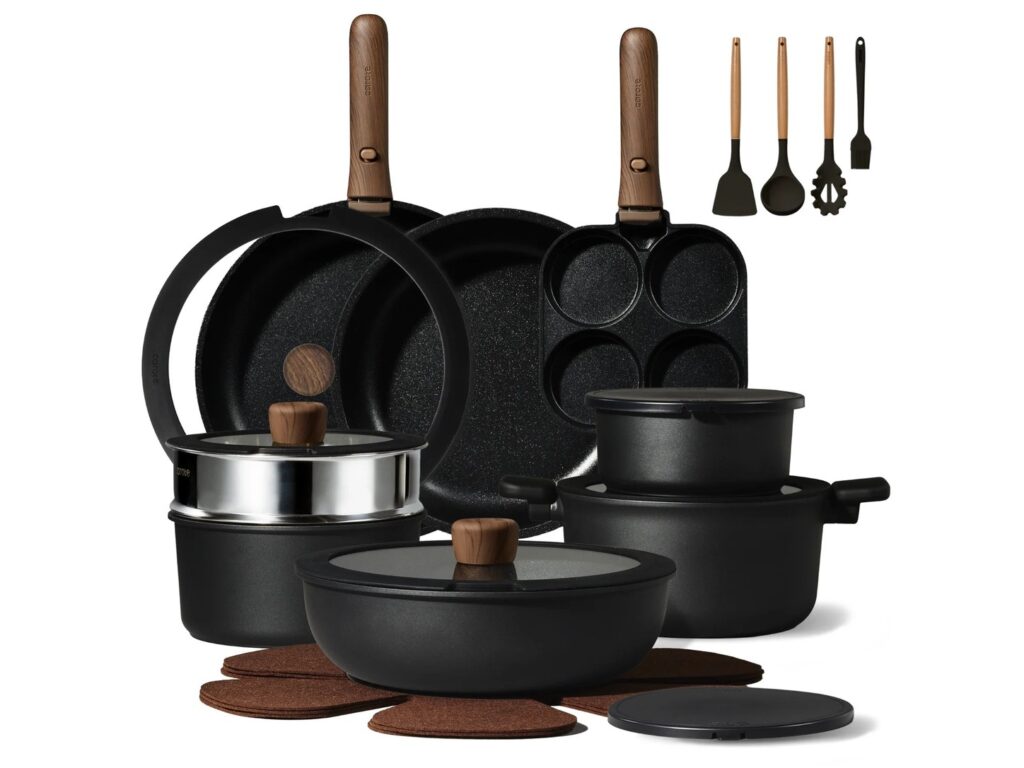
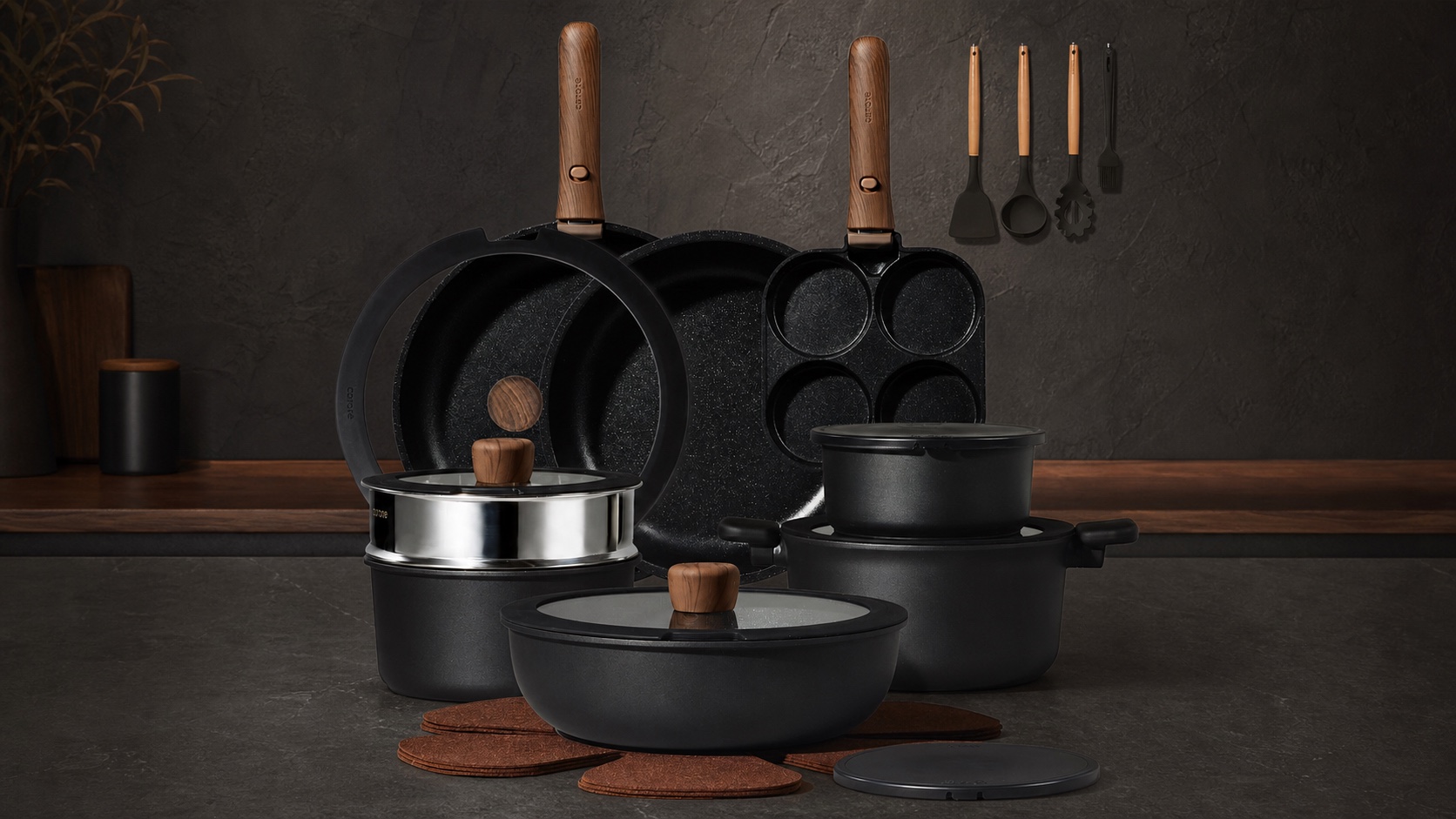
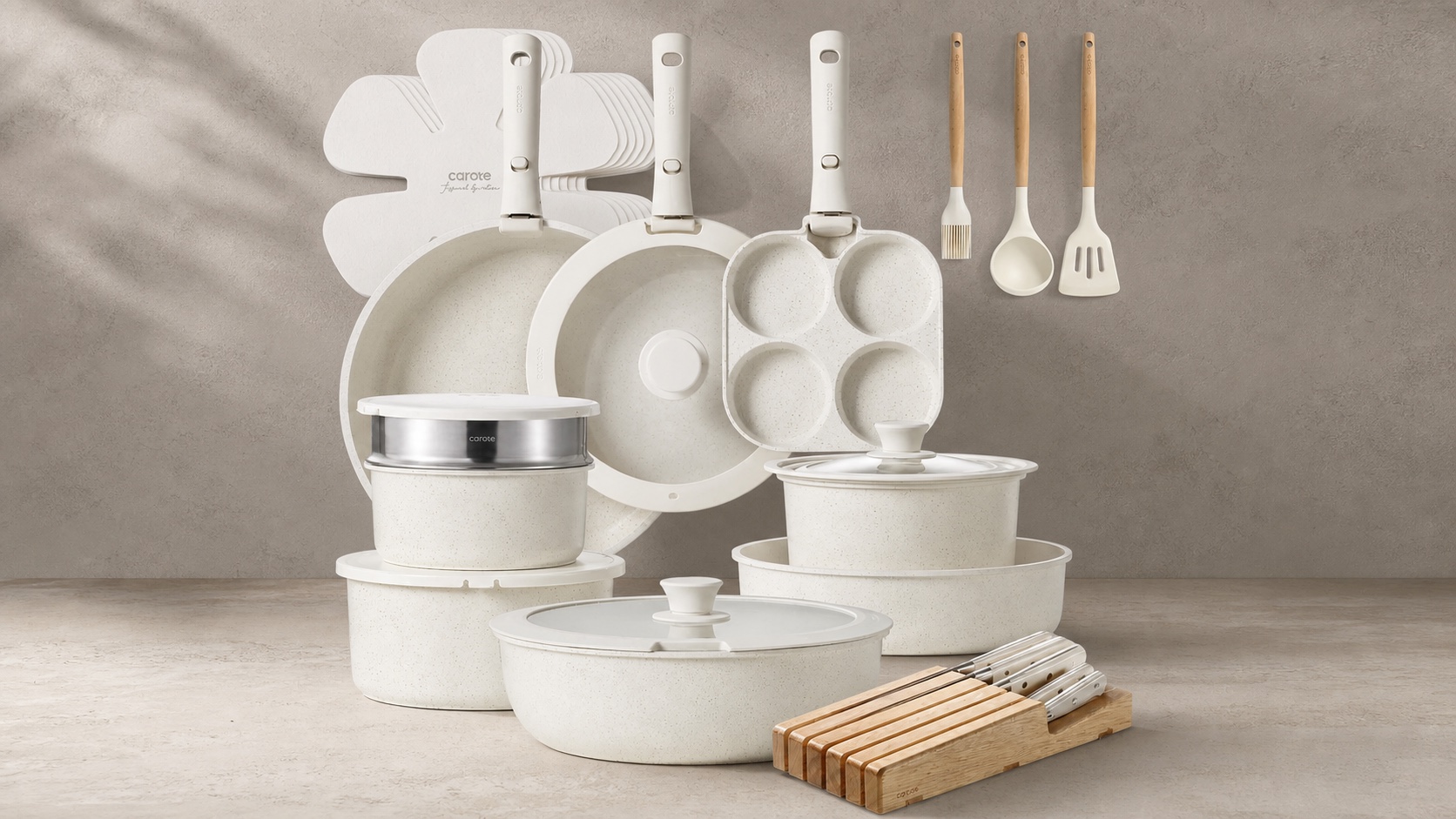
The CAROTE Forest 26-piece set, Snow 33-piece set and SANHO 21-piece set illustrate why the distinction matters. Each includes supporting parts that help the system work, but those parts are not additional cooking vessels.
3. Separate body construction from cooking surface
“Aluminium,” “stainless steel,” “tri-ply” and “non-stick” do not describe the same layer. The body determines structure and heat movement; the cooking surface affects release and care. A set may combine a metal body with an applied coating, so both need to be recorded.
SANHO describes its 21-piece set as a three-layer stainless-steel construction with an aluminium-alloy core and a ceramic non-stick surface. CAROTE describes the Hokkaido range as titanium non-stick. These are maker descriptions, not interchangeable material categories or independently verified durability results.
4. Treat coating language precisely
Terms such as ceramic, granite-effect, titanium or hybrid can refer to appearance, reinforcement or a named coating system. They do not by themselves reveal substrate thickness, service life or scratch resistance. Use the manufacturer’s exact wording and read the care instructions for the specific model.
Avoid assuming that one family represents every product from a brand. The Taste Plus Yuanmu Frying Pan belongs to a broader cookware line; public catalogue material does not establish one universal coating, size or care rule for every Yuanmu configuration.
5. Fixed and detachable handles solve different problems
A fixed handle makes the pan immediately ready and removes a separate part from the routine. A detachable system can reduce storage width and allow a vessel to move between cooking, serving and storage, but it introduces a connection that must be fitted and maintained correctly.
Check how many removable handles are included, which bodies they fit and whether the handle must be removed in the oven. Do not infer oven limits from the pan body alone. Lid knobs, handles and storage covers may have different temperature rules.
6. Compare dimensions and capacities, not names
“Frying pan” or “saucepan” does not establish usable area. Record rim diameter, base diameter and capacity where the maker provides them. A wide pan with steep sides behaves differently from a shallower pan carrying the same nominal diameter.
When exact dimensions are absent, do not estimate them from a photograph. Confirm the current regional listing or contact the seller. Product bundles can vary even when the family name stays the same.
7. Map every lid to a vessel
Count cooking lids and storage covers separately, then note which diameter each serves. One lid may cover more than one body; a storage cover may not be intended for heat. A mismatched list can make a set sound more flexible than it is.
Check whether a lid fits while a detachable handle is attached and whether steam vents, knobs or sealing edges alter storage. The point is not to maximise lid count, but to understand the actual combinations.
8. Verify the complete cooktop configuration
Induction compatibility depends on the base, while oven suitability depends on every assembled part. Gas flames can also reach beyond a narrow base toward a handle. Check the maker’s current instructions for induction, gas, electric, ceramic and oven use rather than applying a brand-wide assumption.
The official SANHO record lists major cooktop types and gives separate instructions for oven use with removable parts. CAROTE listings provide model-specific compatibility and care information. Recheck the exact version being purchased.
9. Test the storage claim against the cupboard
Stackability is only useful if the stack fits the available width, height and shelf load. Measure the cupboard opening, not just its interior. Include lid storage, handle storage and the space needed to lift the upper vessels out.
Detachable cookware can create a compact vertical stack, as the Forest and Snow systems show. It can also concentrate weight and surfaces. Pan protectors may help separate coated interiors, but they add to the package count and need their own place.
10. Decide whether storage flexibility earns the extra parts
A removable handle or storage lid has value only if it changes a real routine: a small cupboard, an RV, a refrigerator workflow or a table-to-hob transition. In a large kitchen where pans remain on open shelves, the same parts may add more management than benefit.
Compare the CAROTE Forest and Snow systems with the brand’s fixed-handle Hokkaido 15-piece set. The contrast is more informative than treating every set as the same architecture with a different count.
11. Read the care routine before the feature list
Note hand-washing or dishwasher guidance, utensil recommendations, heating limits and instructions for stacking. A coating that requires gentle utensils and separators may still suit the household, but the routine should be understood before purchase.
Check whether handles, lids and storage covers have separate cleaning rules. Replacement availability also matters for the small part that makes the system work.
12. Check replacement parts and regional support
Look for handles, knobs, lids and protectors as named replacement items. Confirm that the active regional store supplies them. A set can remain structurally sound while losing usefulness because one proprietary part is unavailable.
Warranty, stock, price and delivery vary by channel. ChinoMuse does not sell these products and cannot confirm service in every country. Use the manufacturer or authorised seller for the current purchase terms.
13. Build a one-page comparison
- Cooking vessels: type, diameter and capacity.
- Body: published metal construction.
- Surface: exact coating or finish wording.
- Handles: fixed or removable, quantity and compatibility.
- Lids: cooking lids and storage covers mapped to bodies.
- Heat: cooktop and oven limits for the assembled configuration.
- Storage: stacked dimensions, protectors and loose parts.
- Care: cleaning, utensils and heating guidance.
- Support: replacements, region and current seller.
14. What the public record cannot establish
Official pages can establish product identity, listed pieces, published materials and the maker’s compatibility claims. They cannot prove even heating in a particular kitchen, long-term coating life, handle comfort, balance or reliability. Those require controlled testing or documented ownership experience.
Choose the smallest set that covers the actual cooking plan and fits the storage space. A well-matched eight-vessel system can be more useful than a larger package whose count is built from accessories.
Editorial scope
This source-led guide was checked against the cited CAROTE, SANHO, Taste Plus and Red Dot records on 15 August 2026. ChinoMuse has not physically tested the cookware. Specifications, bundle contents, availability and care guidance may change; confirm the exact current product page before purchase.