The pen and ruler are among the least surprising objects on a desk. Their uses are settled, their scale is familiar and their mechanisms are easily overlooked. That makes them demanding design subjects. A change that is too loud can interfere with use; a change that is too slight can disappear into a crowded stationery market.
Two KACO records credit designer Lin Fan: the TUBE aluminium gel ink pen and the RUMA aluminium ruler and bookmark. Read together, they show a disciplined approach to familiar objects. Straight geometry, controlled colour and one integrated detail do most of the work. This story is based on cited public records, not an interview, studio visit or physical test.
Lin Fan enters the record through the objects
KACO’s official product presentations name Lin Fan as designer of TUBE and RUMA. That attribution provides a concrete starting point without requiring a broad biography to explain the work. The two objects can be examined through decisions visible in their official records: the pen’s aligned functional parts and the ruler’s folded return.
The credit does not establish that Lin Fan designed every KACO product or every later variant. It establishes a documented relationship to these exact objects. Keeping that boundary clear allows the design reading to remain specific.
TUBE reduces the click pen to aligned parts
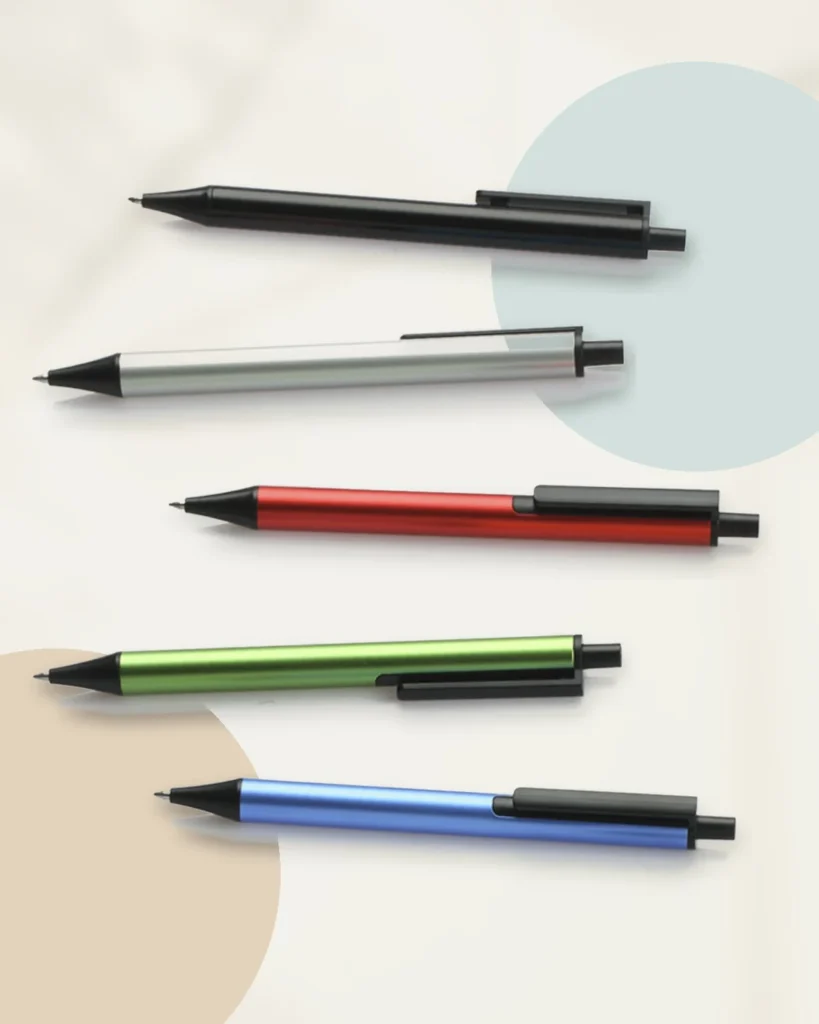
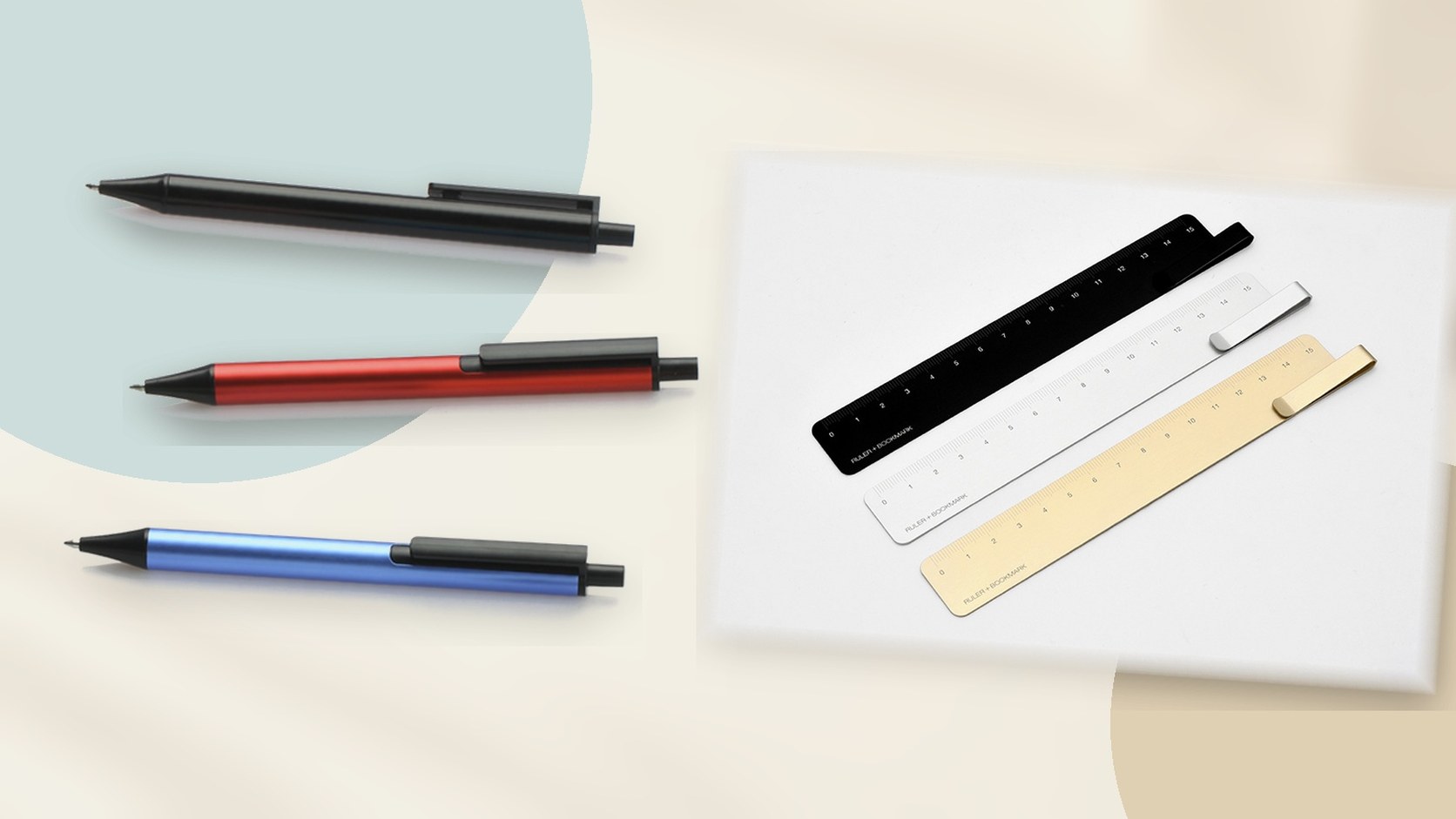
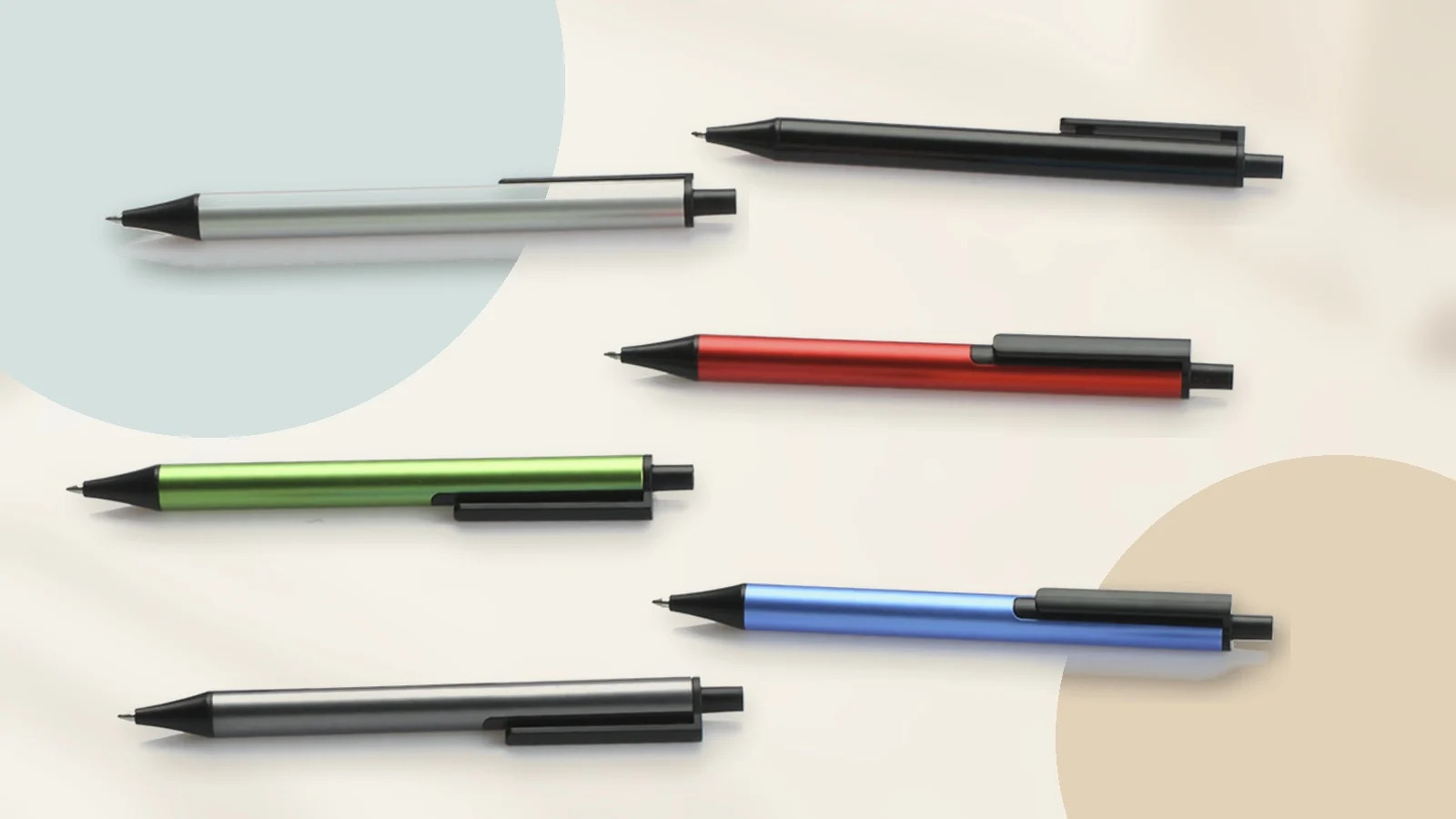
TUBE is a retractable gel ink pen centred on a slim aluminium barrel. The black conical nose, straight clip and short push control form a functional layer around the coloured cylinder. Nothing needs a separate decorative motif to explain the object.
The alignment matters. The clip runs parallel to the barrel instead of becoming an emblem. The click control extends the line at the rear. The nose narrows directly toward the writing point. Each part is distinct enough to read, but no part interrupts the basic geometry.
Colour becomes a system rather than a graphic
KACO’s official imagery presents TUBE in a coordinated range of metal colours. The barrel carries the colour while the tip, clip and control remain visually consistent. That separation lets several pens sit together as a family without changing the mechanism or adding different surface graphics.
Colour therefore supports recognition and selection. It is not evidence that every historic finish remains available. Current colour, refill and package configuration still require confirmation with the active seller.
The aluminium barrel keeps material legible
A regional KACO listing describes the TUBE barrel as anodised aluminium with ABS components and identifies a 0.5mm black gel refill. The material description explains the controlled colour and slender form more usefully than a generic claim of premium quality.
It does not establish balance, grip comfort, drying time, clip strength or finish durability. Those qualities cannot be inferred from official photography. The public record is strongest when it identifies construction and leaves performance questions open.
RUMA makes one fold perform two jobs
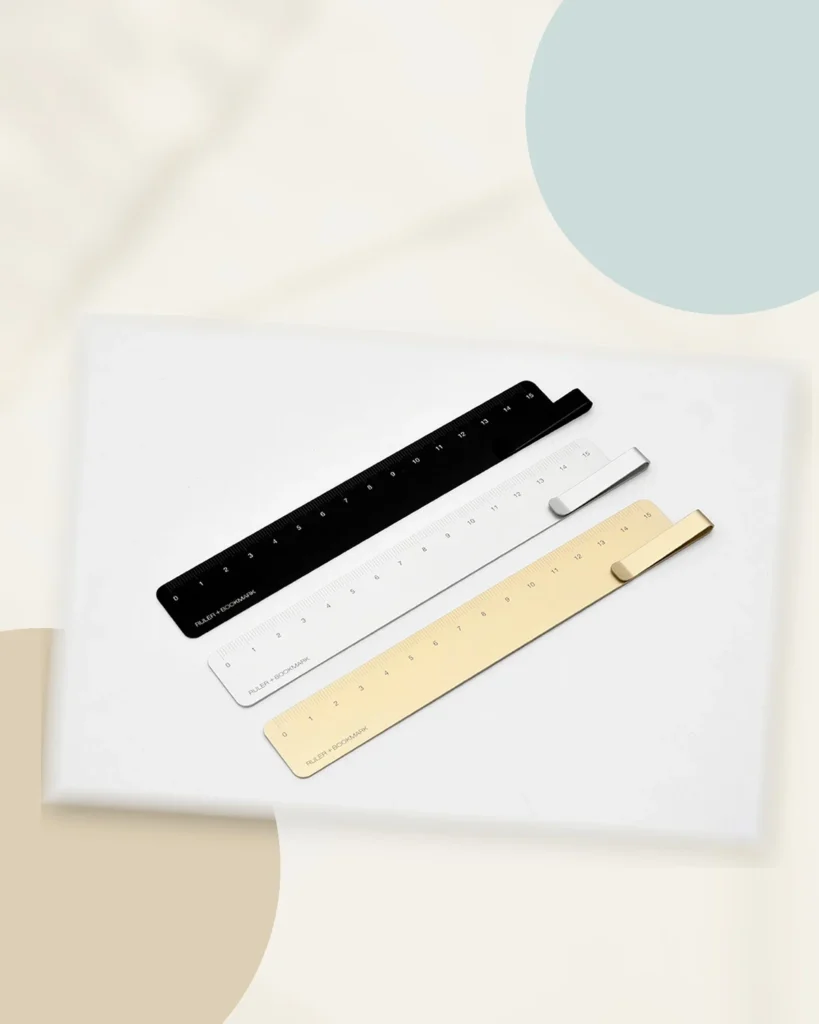
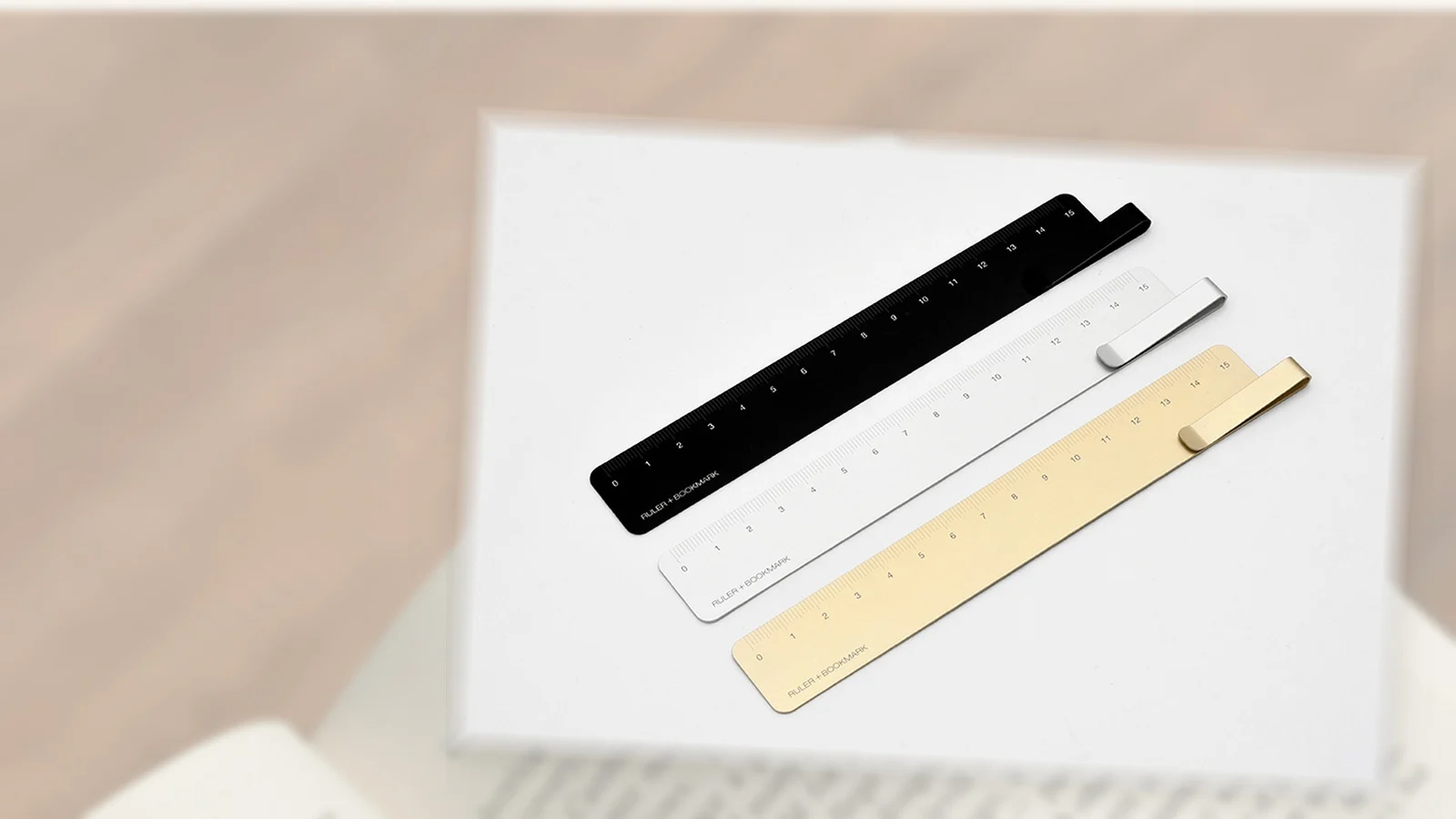
RUMA is a 15cm aluminium ruler with laser-engraved markings and a folded end that acts as a bookmark clip. The second function does not arrive as a detachable accessory. It is produced by returning the material over itself and creating a narrow space for a page.
That move preserves the ruler’s flat measuring body while giving the end a clear direction and purpose. The object remains recognisably a ruler, but the folded return changes how it can stay with a notebook or book between uses.
The shared language is linear
TUBE and RUMA do not look identical, yet their relationship is visible in long uninterrupted lines. The pen uses a cylinder with parallel clip and control. The ruler uses a flat strip with an extended return. Both rely on proportion and alignment before surface decoration.
This linear language suits stationery because the objects already work along a direction: a pen moves through a line of writing; a ruler defines an edge and scale. The design reinforces those actions without turning them into a literal symbol.
Small controls carry the identity
On TUBE, the clip and push control are the main interruptions in the barrel. On RUMA, the folded bookmark is the defining structural event. In both cases, a small functional detail carries more identity than a large logo or graphic field.
That restraint is difficult to maintain in production. Alignment, edge condition, finish and the relationship between joined parts become more visible when there is little ornament to distract the eye. Official records describe the intended objects; they do not allow ChinoMuse to assess manufacturing tolerance in delivered units.
Awards provide context, not a substitute for reading
KACO’s TUBE presentation displays Golden Pin and 2016 Good Design recognition. The regional RUMA store identifies a 2019 iF Design Award. These references help place the objects in a design context, but they should not replace analysis of what the products actually do.
Award information also needs exact scope. Recognition attached to one named product should not be extended to a whole catalogue or every current colour. ChinoMuse records the source-attributed claims and does not present them as its own awards audit.
Everyday scale makes precision visible
A chair or lamp can announce itself through size. A pen and ruler must work within much narrower dimensions. Small changes in taper, clip length, folded depth or edge treatment can affect both appearance and use. The designer has fewer places to hide an unresolved decision.
TUBE and RUMA show how a contemporary stationery brand can concentrate design effort in repeated, low-drama actions: clicking, writing, measuring and marking a page. Their significance lies less in novelty for its own sake than in making those ordinary interactions coherent.
What the public record cannot establish
The cited pages establish product identity, material descriptions, designer credits and published specification details. They do not establish long-term durability, comfort, measurement accuracy, page marking, refill availability in every region or the consistency of current production.
ChinoMuse has not interviewed Lin Fan or KACO, visited a production site, received samples or physically assessed the products. Inclusion does not imply partnership, sponsorship or endorsement. Any interpretation here remains visibly separate from the first-party facts.
Two objects form a designer record
A single product can be an isolated success. Two objects allow a pattern to emerge. Across TUBE and RUMA, Lin Fan’s documented work for KACO favours clear silhouettes, material-led colour and one integrated functional detail. The approach is precise without making the desk feel technical for its own sake.
Explore the KACO brand profile, TUBE Aluminum Gel Ink Pen and RUMA Aluminum Ruler + Bookmark. Together they preserve the exact product sources and the limitations that a design reading should not erase.