

A brand can place its name on every object and still lack a recognisable product language. Songmont’s selected bag records suggest another route: build identity through outline. The Luna is read as a crescent, the Medium Song as a rounded open volume, and the Mini Drippy Roof as a compact body under a sloping top line. Seen together, the three forms do not repeat one template. They make difference itself feel organised.
This story reads current first-party pages and official photography as design evidence. It does not report handling, comfort, durability, capacity or sales performance, and it does not imply a partnership with Songmont. The three products are representative examples rather than a ranking or a complete history of the catalogue.
Silhouette can speak before a logo
A silhouette is the first boundary between an object and its surroundings. In a bag, it determines how the body appears from a distance, how the handle meets the volume and how the object sits against clothing. Recognition can therefore begin before material texture or hardware becomes visible.
Songmont’s official founder story dates the first bag to 2013 and connects Fu Song’s user-experience design background with a family craft network in Shanxi. That account helps explain the brand’s emphasis on practical forms, but the current product language cannot be reduced to one origin anecdote. It is visible in the way different bag families turn simple geometric ideas into distinct characters.
Luna draws a continuous crescent
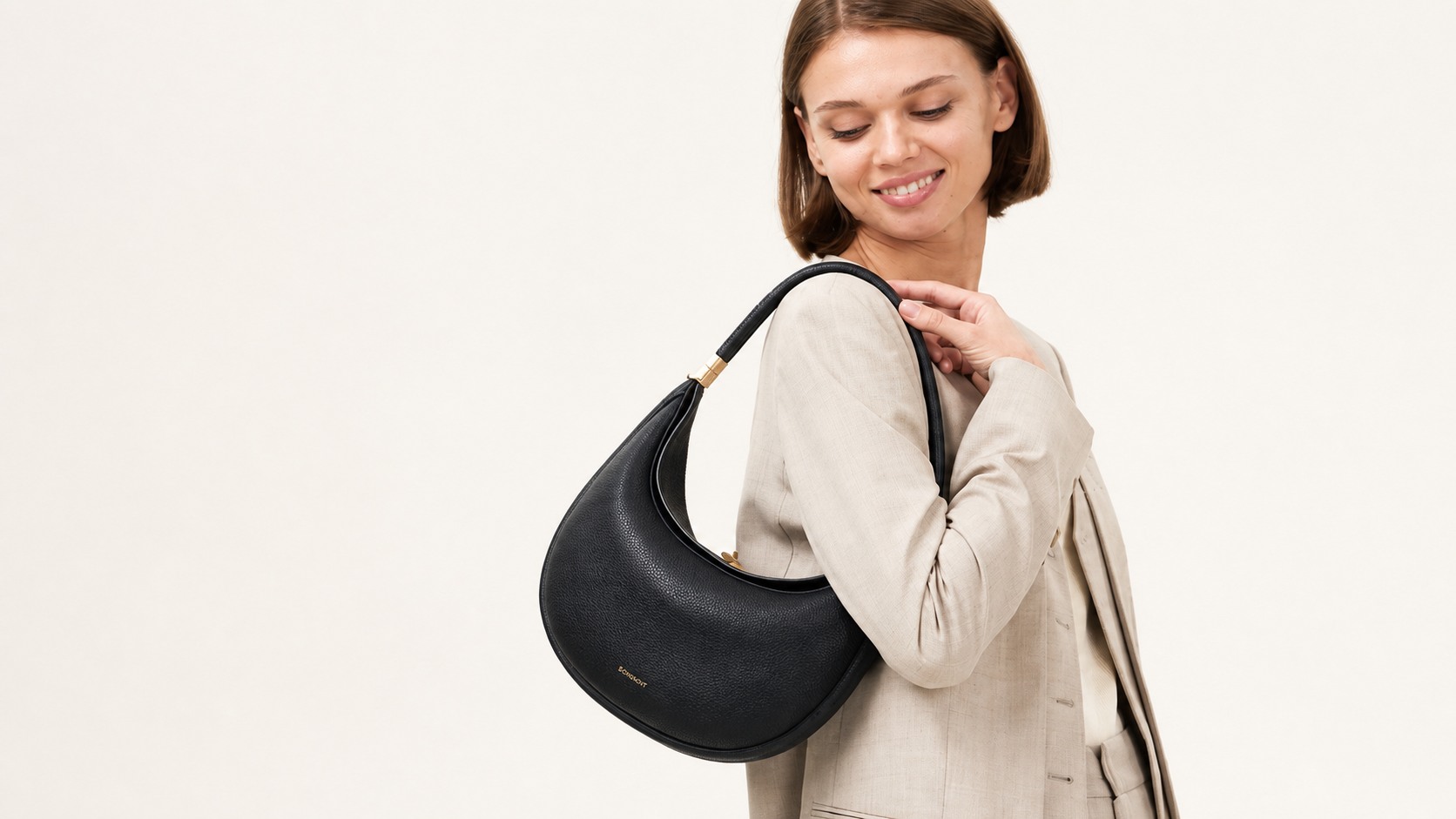
The Luna Bag is organised around a curve. Its body rises toward the ends and falls through the centre, while the strap can visually continue that movement. In the Onyx version, a dark surface makes the outline especially legible against a pale garment. The result is less like a rectangular container suspended from a strap and more like one continuous arc.
The official record identifies full-grain leather, a magnetic closure, a listed weight of 450 g and an adjustable 82–96 cm strap. It also describes four ways to wear the bag. Those facts show that the crescent is intended to support more than one configuration. They do not prove that every configuration has the same balance, access or comfort; those qualities remain outside a source-led visual reading.
Song turns a soft volume into a recognisable body
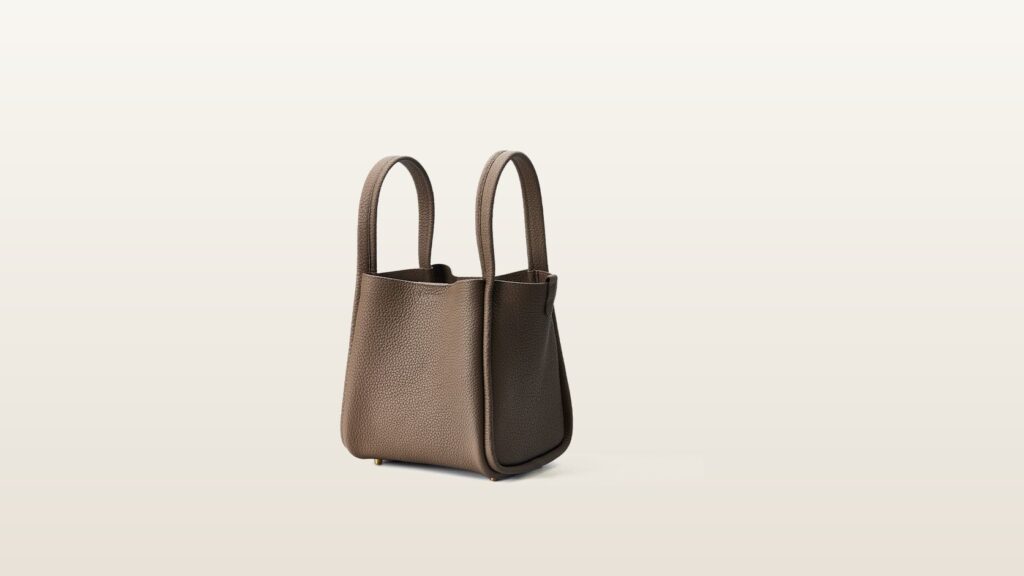
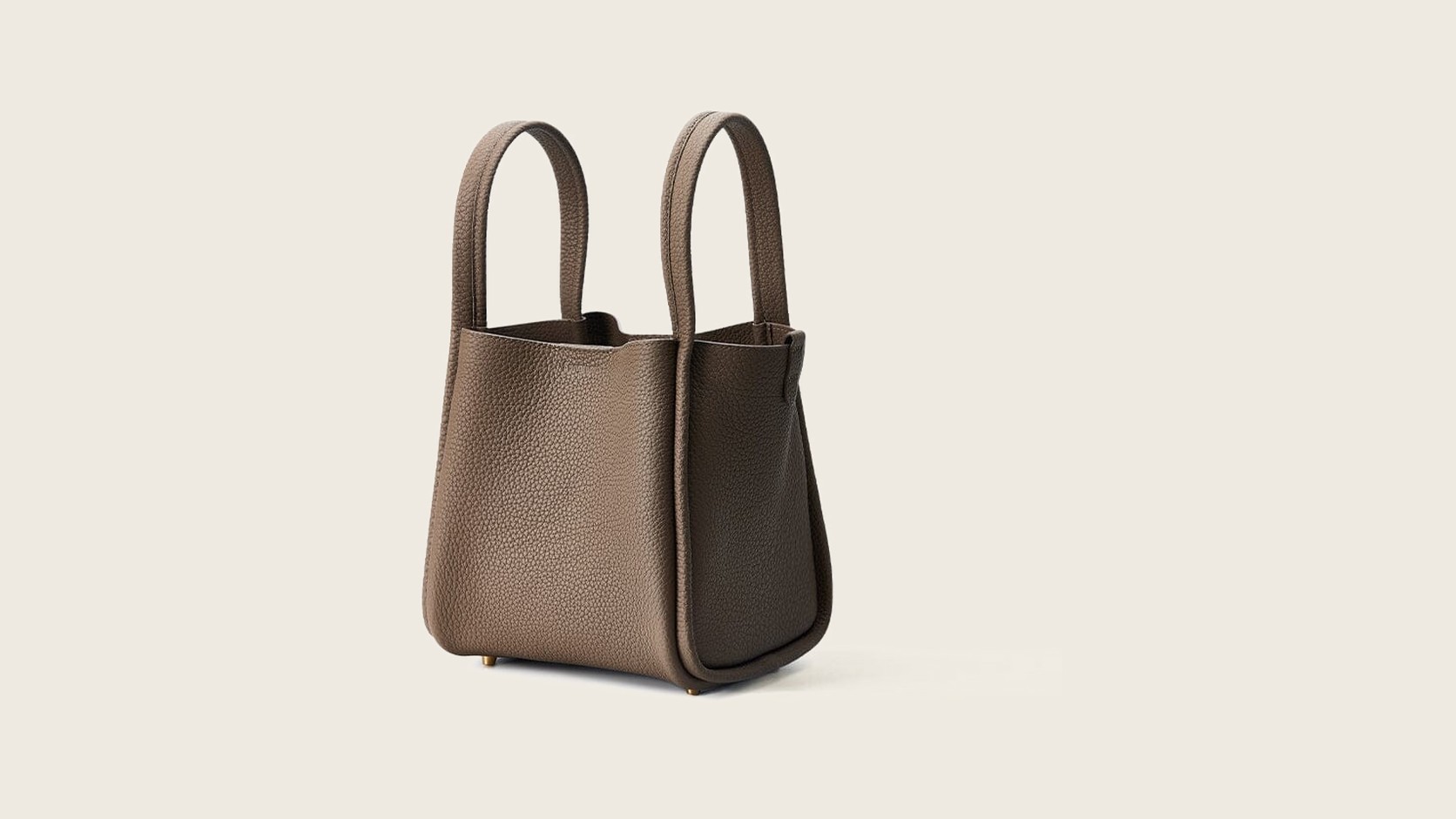
The Medium Song Bag uses another logic. Rounded handles rise from a broad body whose edges appear softened rather than sharply framed. The silhouette presents volume directly: the eye reads a container, two loops and a grounded base. Four listed metal feet add small points of contact beneath that rounded mass.
Inside, the official page describes a magnetic single compartment and a removable zipped inner pouch. This is important to the design language because the exterior can remain visually simple while organisation is moved into a separate component. The checked record also lists full-grain leather, 480 g weight and a 76–88 cm adjustable strap. These details establish construction claims, not measured capacity or shape retention.
Drippy Roof makes the upper edge the main event
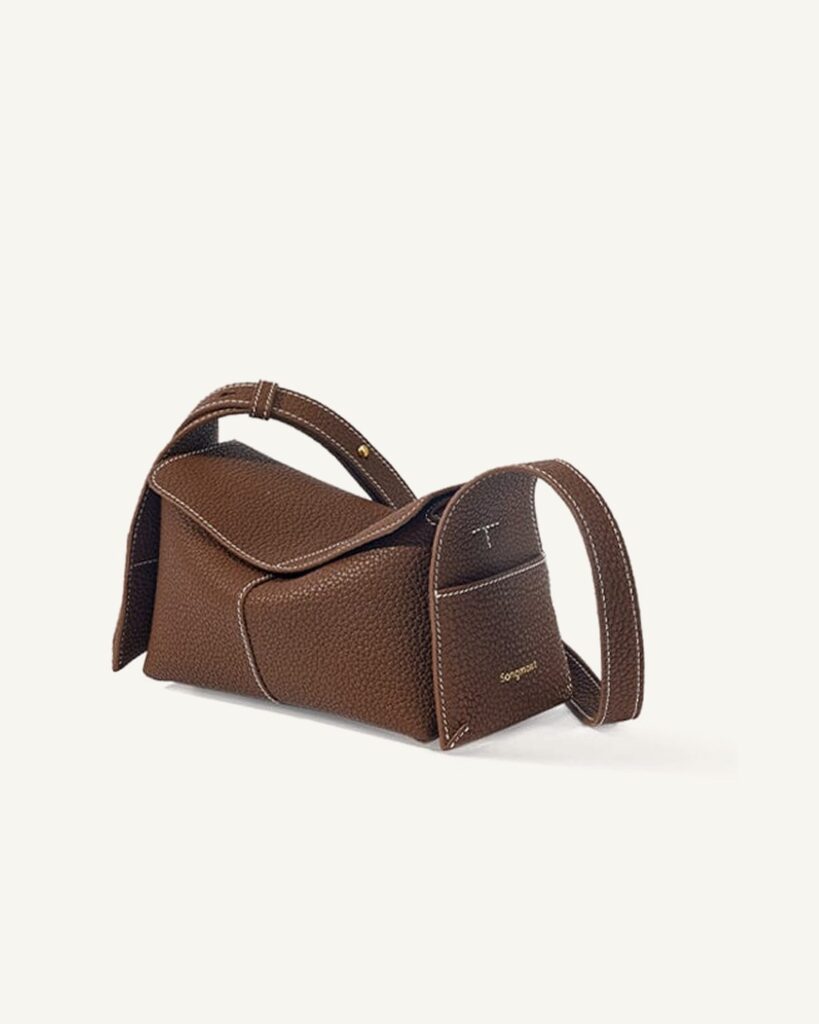
The Mini Drippy Roof Bag is identified by its top line. One side rises toward a roof-like peak while contrast stitching traces the perimeter of the Chocolate version. A short handle follows the upper structure, and a longer strap allows the compact object to sit away from the hand. The asymmetry makes the bag directional: it has an obvious front and an outline that can be recognised at small scale.
Songmont’s checked page lists full-grain leather, a microfibre lining, 350 g weight, an 81–120 cm adjustable strap, four metal feet and stainless-steel hardware with a vacuum-electroplated finish. The verified record used here does not establish opening dimensions, usable volume or closure behaviour. The roof metaphor is therefore a description of form, not evidence of function beyond the published facts.
Three openings create three visual rhythms
The top of a bag is both an access point and a line in the composition. Luna’s magnetic closure sits within a curving body. Medium Song’s magnetic single compartment is framed by two rounded handles. Drippy Roof’s sloping upper edge makes the question of access visually inseparable from its character, even though the exact geometry must be checked on the current product page.
These differences shape how the eye moves across each object. A continuous curve suggests flow, paired handles create repetition, and a roof line introduces a peak. None of those visual effects tells a buyer whether a phone fits or a closure is secure. Design interpretation and purchase verification are related, but they are not the same claim.
Straps redraw the silhouette on the body
A bag does not retain one outline after it is worn. The strap adds a line between shoulder and object, changes the height of the body and can rotate the form. Luna’s maker-described carry configurations make this transformation part of the product proposition. Medium Song’s shorter listed range and Mini Drippy Roof’s broader listed range create different possible relationships between bag and torso.
Official lifestyle photography demonstrates intended positions and visual proportion. It cannot establish universal fit because height, clothing and adjustment alter the result. Still, the images reveal an important part of Songmont’s product grammar: the object is designed to be recognised both on its own and as a line drawn across a person.
Material continuity holds different forms together
The selected records share a maker-stated full-grain leather exterior, yet their forms distribute that material differently. Luna uses it through a curved crescent, Medium Song through a rounded volume, and Mini Drippy Roof through a more graphic outlined body. Shared material creates continuity without forcing the silhouettes to become variants of one shape.
The interiors and hardware descriptions prevent that continuity from being mistaken for uniform construction. Luna’s checked page says lining may be synthetic leather or fabric with random delivery. Medium Song describes a removable pouch with fabric/full-grain leather in its listing. Mini Drippy Roof names a microfibre lining. Hardware finishes also differ in the published records. A family resemblance can coexist with version-specific details.
Recognition comes from controlled difference
Some ranges create identity by repeating a signature part. In these three Songmont examples, recognition emerges through a controlled set of contrasts: curve against rounded volume, symmetry against asymmetry, close continuous arc against distinct handle and body. The products are not visually identical, but each makes its governing shape easy to name.
That naming matters. “Crescent,” “Song” and “roof” give editors and buyers a stable way to distinguish families before discussing colour. The official catalogue also contains other sizes and variants, so these three records should not be treated as a complete map. They show a method rather than every result of the method.
Official photography stages form as evidence
Neutral-background stills isolate the outline. Lifestyle images place the bag against clothing or carved surfaces, introducing scale and atmosphere. Used together, they show which edge, handle or curve the brand wants the viewer to notice. They are useful editorial references when their source URLs and exact product identities remain attached.
Photography also has limits. Lighting can deepen colour, a chosen angle can conceal depth, and styling can make a soft form appear more structured. A model image cannot verify fit, while a carefully filled still cannot establish empty behaviour. ChinoMuse therefore uses official public images as limited editorial quotation and does not present them as owned, authorised, independently tested or supplied through a collaboration.
A product language is not a performance verdict
It is possible to describe why a silhouette is distinctive without declaring the bag successful in use. Long-term leather behaviour, strap comfort, closure strength, hardware life and repair experience require evidence that these public records do not provide. The same boundary applies to broad claims about craftsmanship or quality: a material label is not an independent assessment.
This distinction protects the design story from becoming disguised promotion. The useful conclusion is not that one shape is better. It is that Songmont uses outline, opening, handle and strap as a coordinated vocabulary, giving three everyday bags separate identities while retaining a visible relationship.
Three forms make a compact brand grammar
Luna contributes the continuous crescent, Medium Song the rounded body with paired handles, and Mini Drippy Roof the small architectural peak. Together they show how a bag range can expand by varying its primary geometry rather than decorating a single base model. The common thread lies in clarity: each silhouette can be reduced to a simple verbal and visual idea.
Explore the Songmont brand profile and the verified records for the Luna Bag, Medium Song Bag and Mini Drippy Roof Bag. The product pages document exact facts and version limits; the silhouettes show how those separate objects become a range.