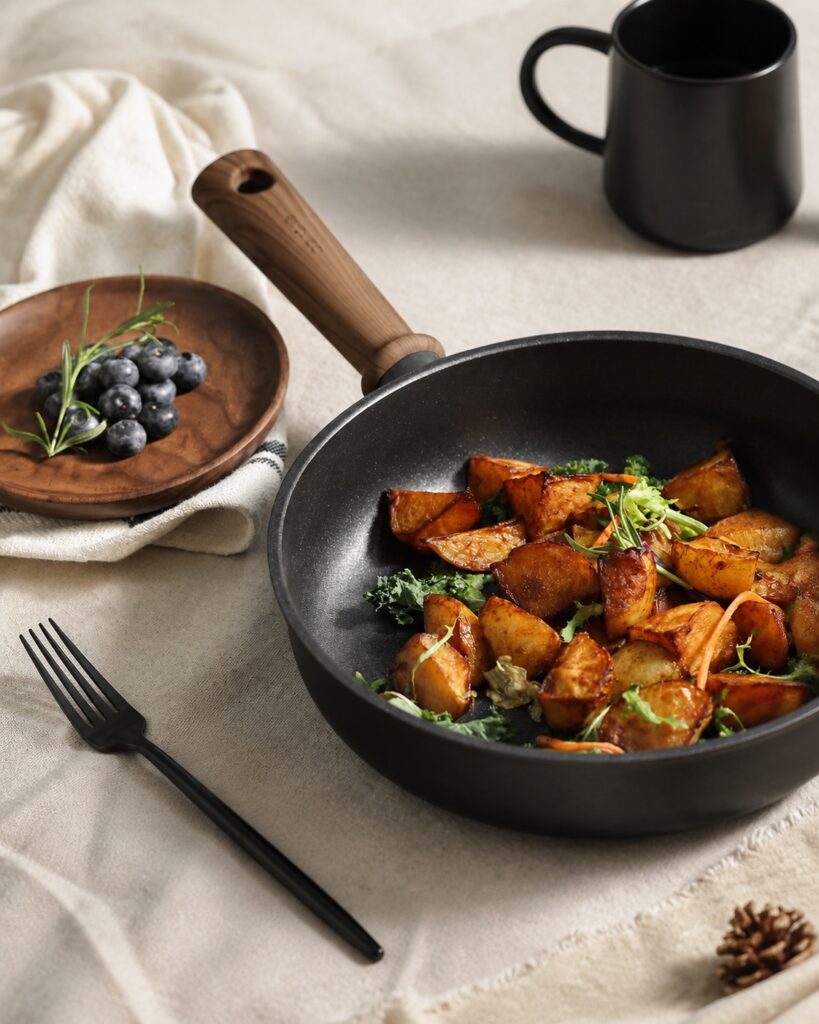
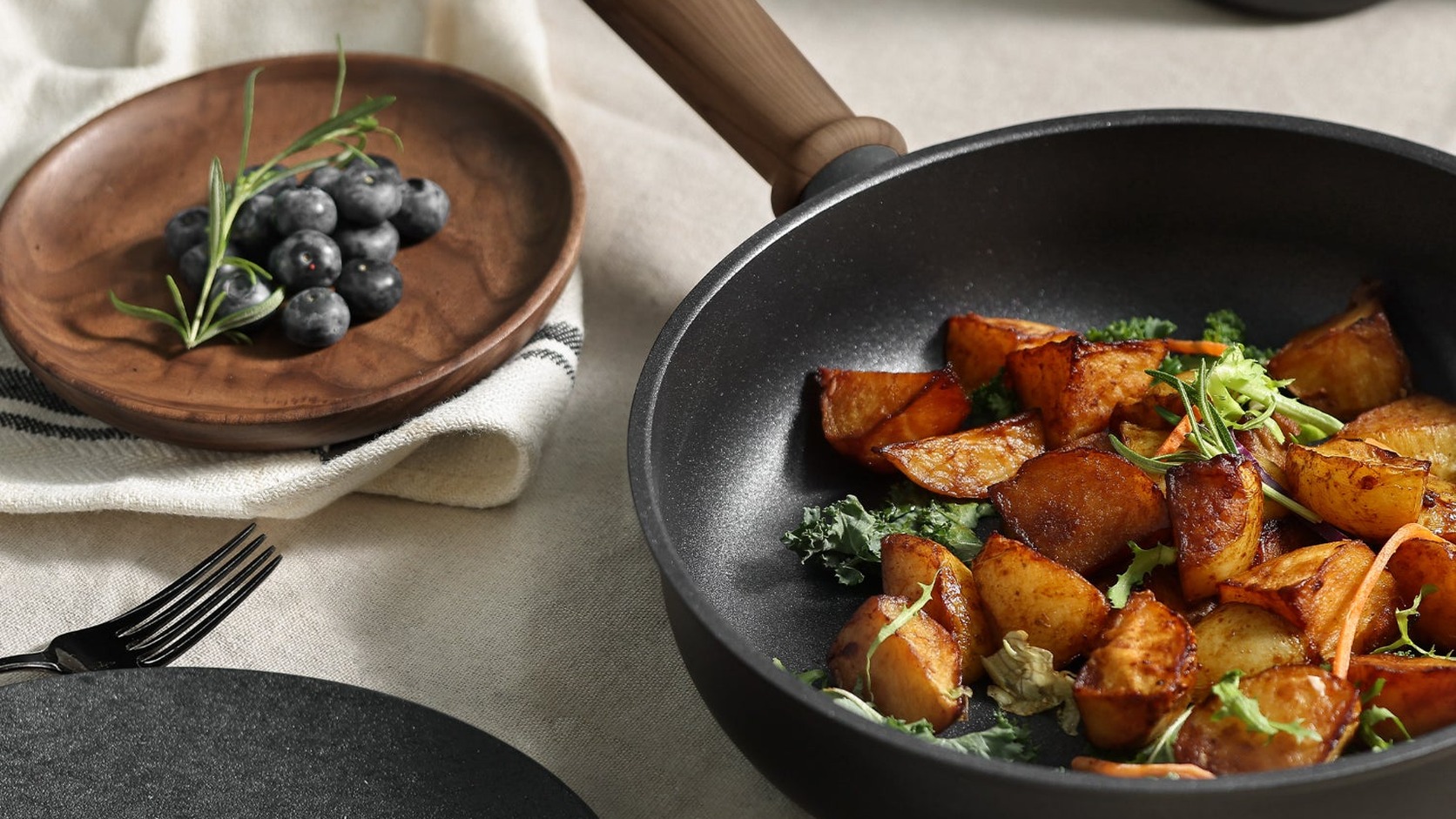
Cookware is usually pictured in use: a pan on heat, a pot holding dinner, a lid lifted through steam. CAROTE’s Forest and Snow collections ask the object to perform another role once cooking stops. Handles detach, vessels nest and storage covers join the set. The cupboard and refrigerator become part of the product’s design territory.
The Hokkaido collection provides a useful contrast. It is a smaller fixed-handle set rather than another detachable stack. Read together, the three current records show that CAROTE is not relying on one silhouette. It is organising cookware around different relationships between cooking, storage and handling.
The handle is the hinge of the system
On a conventional pan, the handle defines orientation and occupies space even when the vessel is idle. A detachable handle changes that permanent outline. The same body can move from hob to table or storage without carrying the full horizontal span.
That change is not purely visual. The connection becomes a critical part that must lock, release and be stored. CAROTE’s system therefore extends beyond the pan body to the number of handles supplied and the instructions governing their use.
Forest presents cookware as a dark, unified kit
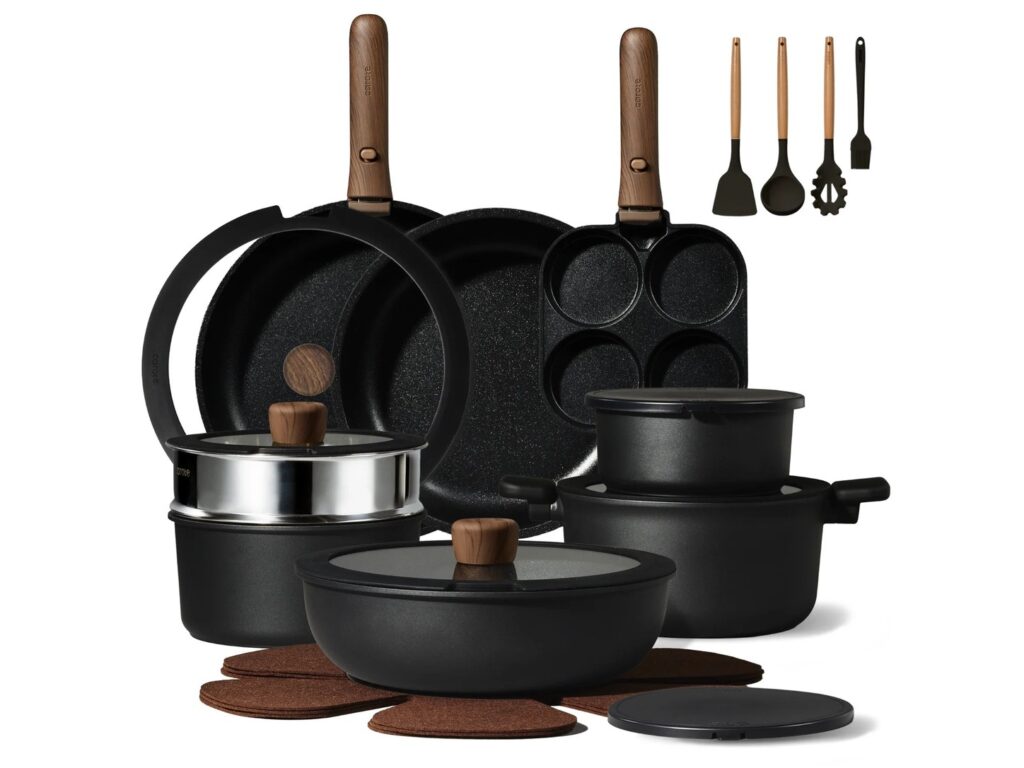
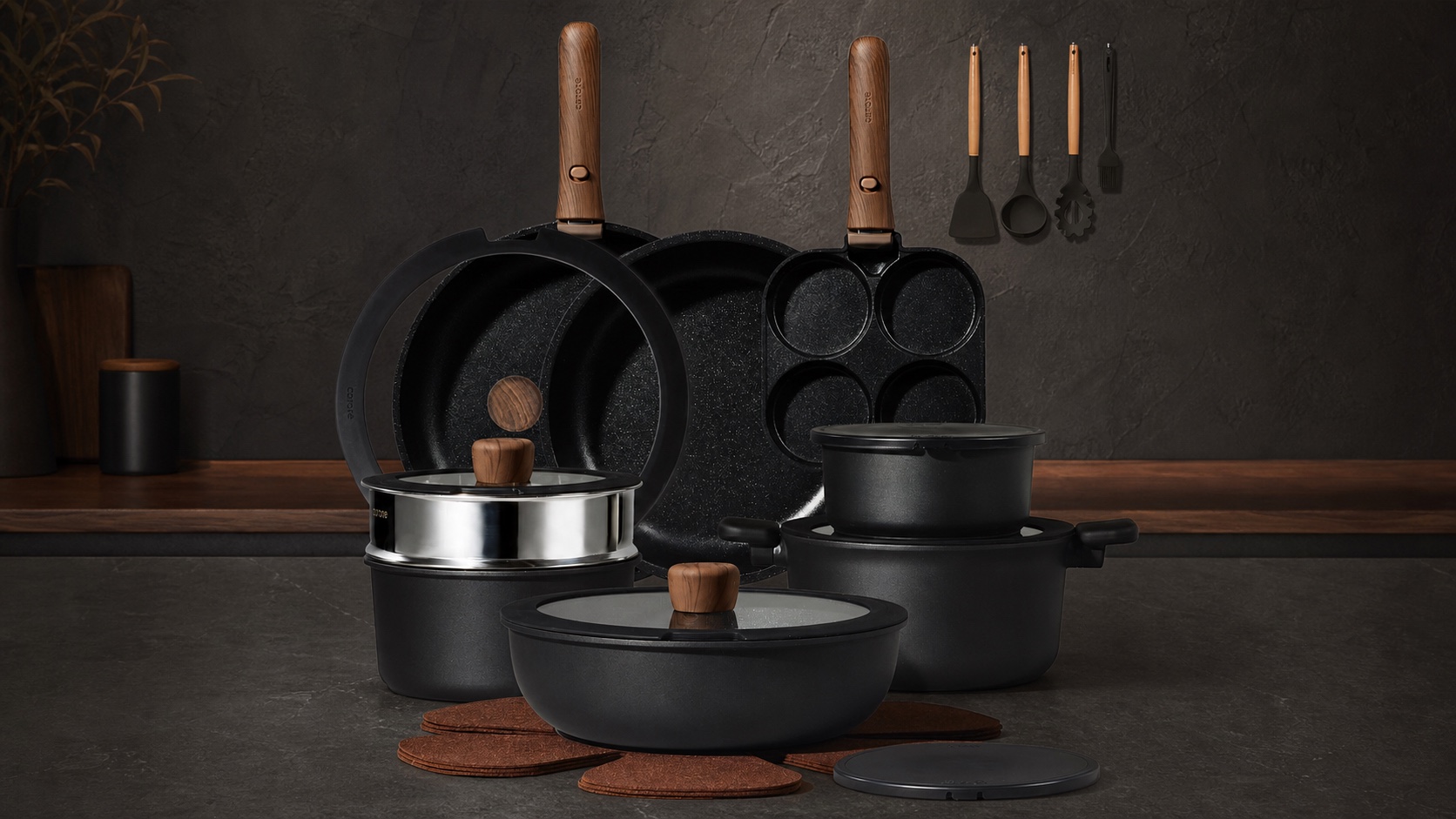
The Forest Detachable Cookware Set — 26 pcs uses dark vessels with wood-look handle details. The group reads as one kit because repeated finishes carry across differently sized bodies and accessories.
Its piece count includes more than pans. Lids, storage covers, protectors, utensils and detachable handles support the transition between cooking and keeping. The value of the set rests on those relationships rather than on 26 separate cooking functions.
Snow expands the pale storage system
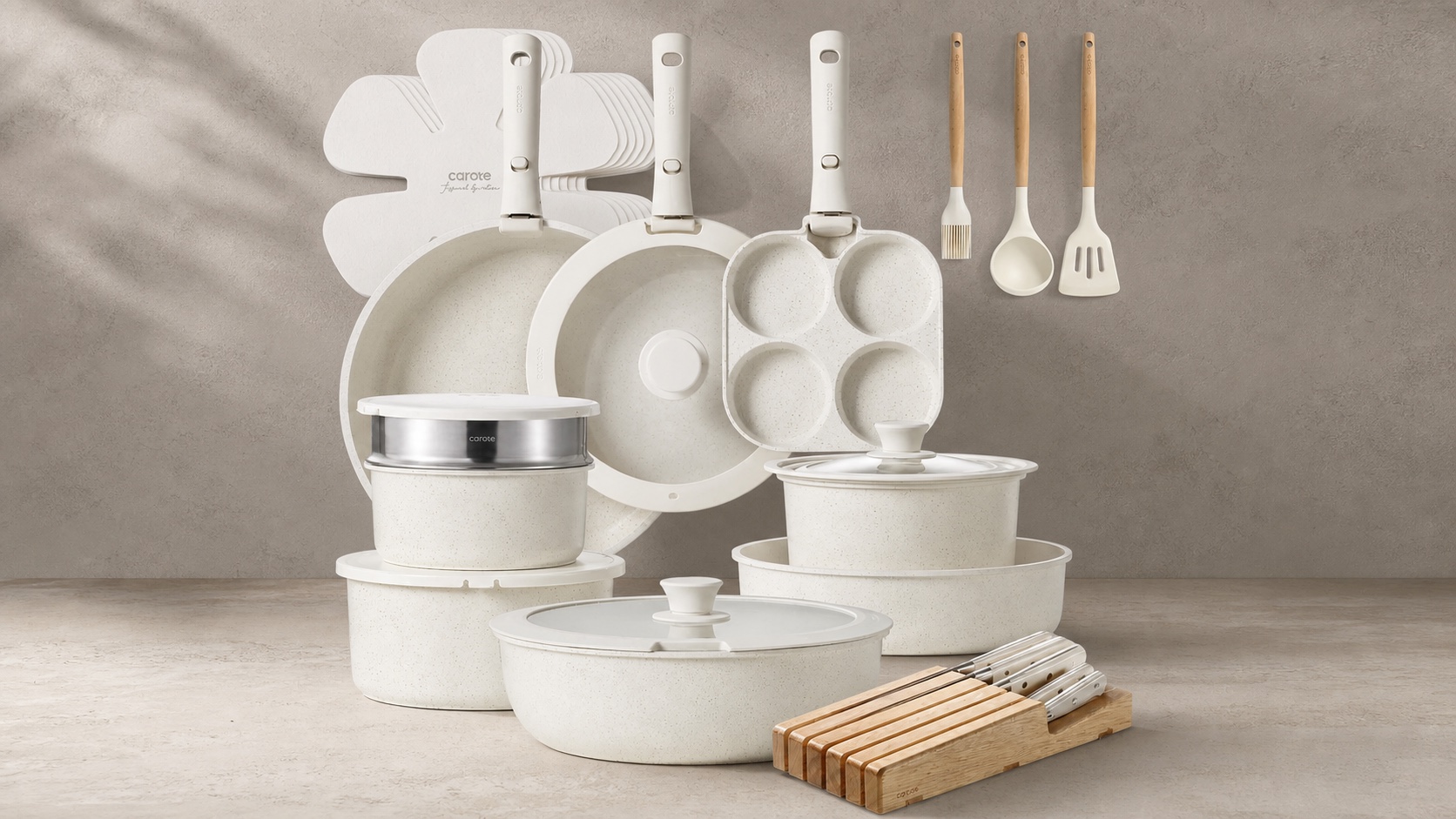
The Snow Detachable Cookware Set — 33 pcs enlarges the system and shifts to a pale finish. The visual change makes stacked forms and covered containers read more like an organised storage family.
Again, the total combines vessels with supporting components. A larger bundle can serve a household that uses several formats, but its usefulness depends on cupboard dimensions, lid management and whether the detachable routine is genuinely needed.
Detachment changes the object at rest
Most product photography privileges the active moment. Detachable cookware is also designed for the inactive moment. Without fixed handles, circular bodies can nest more closely and occupy a more regular footprint.
This is a modest but meaningful design move. The product is no longer complete only when assembled. Its disassembled state is intentional, and the user moves between those states as part of ownership.
Storage covers connect kitchen zones
A storage cover allows a compatible vessel to leave the hob and enter a refrigerator or cupboard as a container. That can reduce transfers, but the function depends on the exact cover, body and current handling guidance.
CAROTE’s detachable sets make that transition visible in the package architecture. They also introduce loose components whose location must remain obvious. Flexibility creates a storage benefit only when the parts themselves stay organised.
Hokkaido chooses a different architecture
The Hokkaido Hybrid Cookware Set — 15 pcs returns to fixed handles and a smaller black collection. CAROTE describes it as titanium non-stick. The record does not support treating it as a detachable variation of Forest or Snow.
Its presence in the range matters because it preserves immediate handling. No separate attachment is needed before lifting the pan. The trade-off is a less compact resting outline and less interchangeability between cooking and storage states.
Piece counts reveal product architecture
Twenty-six, 33 and 15 pieces sound like a progression in size, but the numbers describe different assemblies. The first editorial task is to separate vessels from lids, utensils, handles and protectors. Only then does the logic of each set become clear.
This is also why product titles should retain the maker’s piece count while the body copy explains it. Removing the count loses identity; treating every piece as a pan misleads.
Material language needs restraint
CAROTE uses named finishes and coating language across its listings. Public pages can record those descriptions, but they do not independently establish service life, heat distribution or comparative performance. “Titanium non-stick,” for example, should remain attributed to the maker.
Colour and surface treatment still play a design role. Forest’s dark finish, Snow’s pale bodies and Hokkaido’s black fixed-handle form create three distinct readings of the kitchen object without proving that one performs better.
Flexibility transfers work to the user
A detachable system saves space by asking the owner to attach, release and store parts. A fixed system removes that step but keeps the handle in the cupboard. Neither approach eliminates compromise; each places it at a different point in the routine.
The relevant question is whether the household benefits from the transition. Small cupboards, mobile kitchens and refrigerator storage can make nesting valuable. Open shelving or frequent single-pan cooking may favour immediate access.
A brand range built around more than appearance
The three records suggest that CAROTE distinguishes collections through system design as well as colour. Forest and Snow organise multiple bodies around removable handles and storage components. Hokkaido keeps a more conventional fixed-handle relationship.
That does not establish a company-wide design doctrine or market trend. It does show that the current public range offers two different answers to the same domestic question: what should cookware become when it is not on the heat?
Availability remains regional and changeable
Bundle contents, finishes, stock, prices and delivery can differ between regional listings. A family name does not guarantee that every market receives the same combination. Buyers should compare the current itemised contents with the space and cooktop they intend to use.
ChinoMuse does not sell CAROTE products or process orders. Current terms, replacement parts, care guidance and warranty need confirmation through the active manufacturer or authorised seller channel.
What the public record establishes
CAROTE’s official pages establish the named collections, listed package contents and the maker’s descriptions of materials, compatibility and intended storage functions. They show how the objects are arranged and which supporting parts belong to each set.
They cannot establish long-term coating life, handle reliability, real-world stack stability or cooking performance in a particular kitchen. Those questions require testing or documented use that is outside this profile.
Reading CAROTE through the cupboard
The most revealing view of Forest and Snow may not be the pan on a flame. It is the nested stack after the handle has been removed. Hokkaido makes the opposite case: the handle remains part of the ready object.
Together, the collections make storage an explicit design variable. CAROTE cookware is not one system repeated at three scales, but a range in which flexibility and immediacy are balanced differently.
Editorial scope
This independent brand story was checked against the cited CAROTE corporate and product pages on 15 August 2026. ChinoMuse did not interview CAROTE and has not physically tested the cookware. No partnership, sponsorship, endorsement, sales trend or performance guarantee is claimed. Specifications and availability may change.