
Chinese tradition enters contemporary design most convincingly when it becomes a method rather than a decoration. A silhouette can be copied in an afternoon. A way of working with proportion, material, craft and use takes longer to understand.
That distinction sits at the centre of Jiang Qiong’er’s public practice and the design language of SHANG XIA, the brand she co-founded with Hermès. Their story is not a simple revival of historical forms. It is an effort to make cultural inheritance active inside present-day objects.
A practice formed between disciplines
Jiang Qiong’er’s official biography describes her as an artist, designer and co-founder of SHANG XIA. Her work moves across art, architecture, interiors, furniture, jewellery and objects. That range matters because it changes the scale at which design is read: a cup can be considered as part of a table, a chair as part of a room and a material as part of a longer cultural system.
Her public statement speaks of interpreting tradition in a contemporary way. The phrase is broad, but it points to a useful tension. Tradition is not frozen evidence from the past; contemporary design is not an obligation to erase the past. The work lies in deciding what can change and what should remain legible.
SHANG XIA as an art of living
SHANG XIA’s official history says the idea was conceived by Hermès and Jiang Qiong’er and developed around a contemporary Chinese art of living. The brand’s scope—furniture, tea culture, home objects, accessories and clothing—places daily use alongside collectible craft.
This breadth is important. It frames design as a relationship among objects rather than a sequence of isolated products. Tea ware establishes gesture and pace. Furniture establishes posture and space. Materials establish touch, weight and maintenance. Together they describe how a room or ritual might feel.
The brand was conceived in 2008 and launched in 2010 according to its current timeline. Those dates locate SHANG XIA within a period when Chinese design was increasingly presented internationally through contemporary brands rather than only through manufacture or historical collections.
Tradition as a working system
A historical reference can operate at several depths. At the surface, it can appear as a motif. At a structural level, it can shape joinery, balance, sequence or the relationship between materials. SHANG XIA’s strongest official examples are useful because they make the deeper levels visible.
The brand’s craft pages emphasise the meeting of inherited techniques with contemporary applications. That does not make every object a direct continuation of one historical artefact. It describes a method of inquiry: identify a cultural or technical principle, then test how it can inhabit a current material, scale and use.
The Bridge tea set: material becomes structure
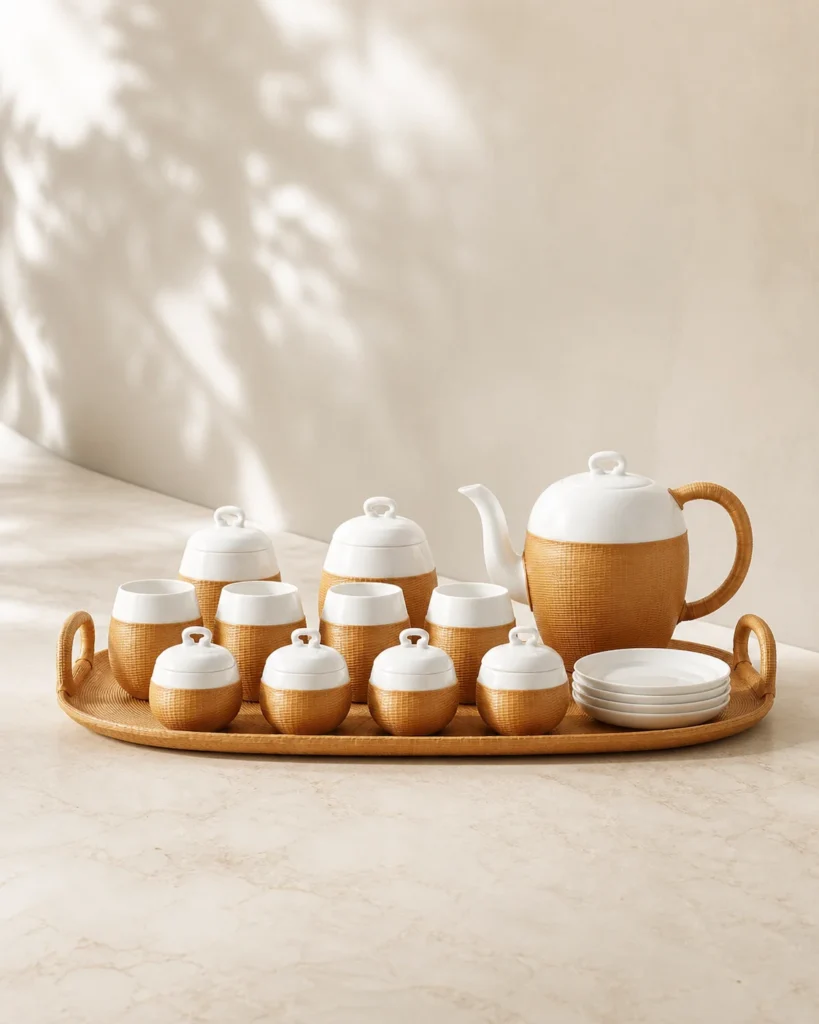
The SHANG XIA Bridge Porcelain and Bamboo Tea Set brings high-fired white porcelain together with fine bamboo weaving. The bamboo is not presented as a printed pattern or colour reference. It forms a second material layer around parts of the porcelain service.
That relationship changes how the set is read. Porcelain brings smoothness, density and a precise white surface. Bamboo introduces fibre, rhythm and the evidence of handwork. The contrast is visual, but it is also tactile and structural. Neither material is asked to imitate the other.
The official product record supports the material description. It does not, by itself, establish handling comfort, thermal behaviour or long-term durability. Those questions would require direct use. What can be seen is a design decision that lets two established material traditions remain distinct while operating as one object.
Da Tian Di: an old furniture logic in carbon fibre
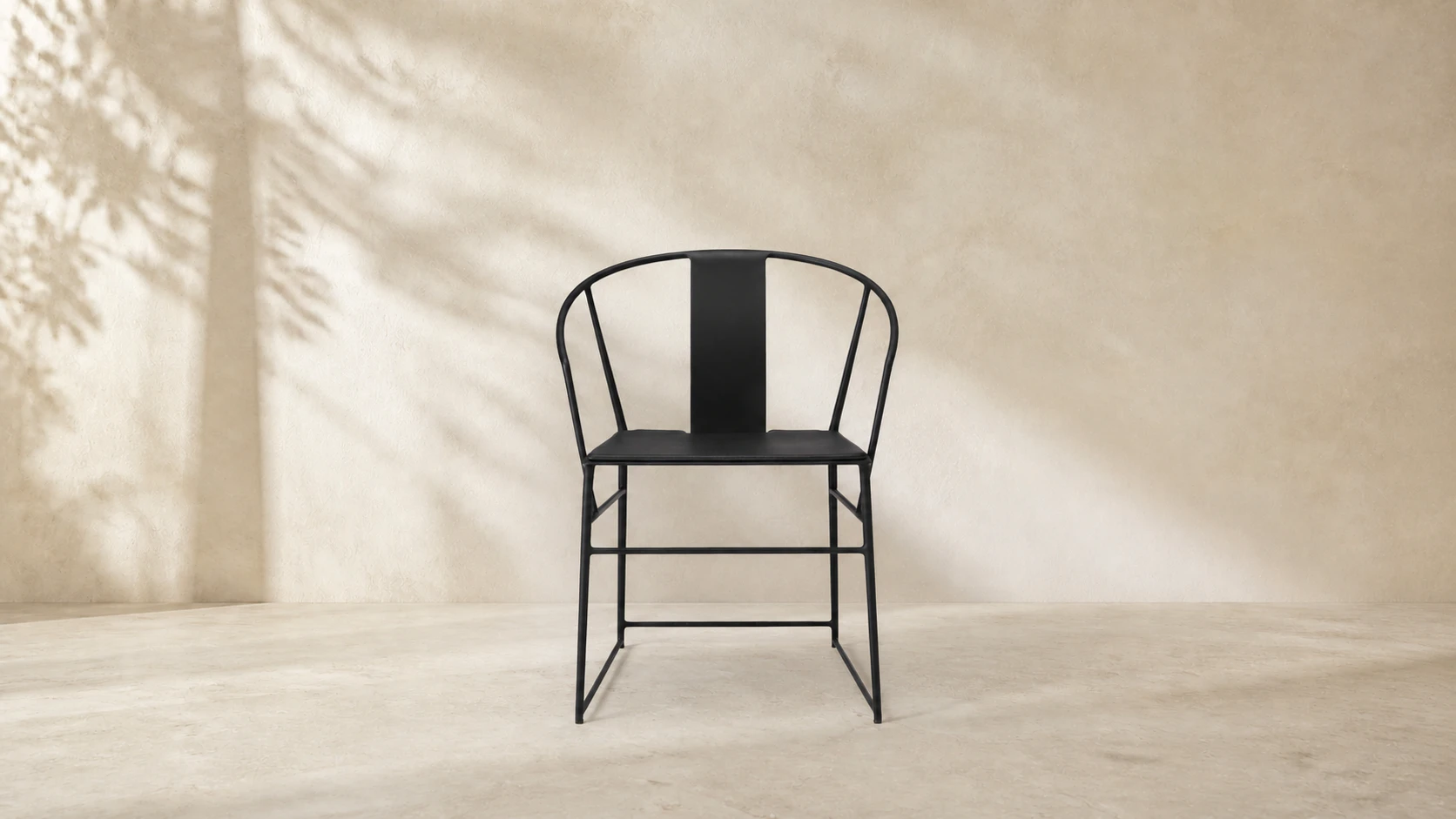
The Da Tian Di Carbon Fiber Arm Chair makes a different move. SHANG XIA describes it through the form of a Ming-style Guanmao chair and the use of carbon fibre. The official page also identifies a thin seat, mortise-and-tenon construction and extensive hand polishing.
Carbon fibre carries associations with lightness and technical performance. The Guanmao form carries a recognisable furniture lineage. Putting them together could have resulted in a novelty object. The design is more interesting when read as a transfer of structural thought: familiar proportions and joint logic are reconsidered through a material that belongs to another industrial history.
The chair therefore refuses an easy division between craft and technology. Hand finishing does not disappear because the material is contemporary, and the contemporary material does not need to disguise itself as wood.
The Go set: culture held in an object system
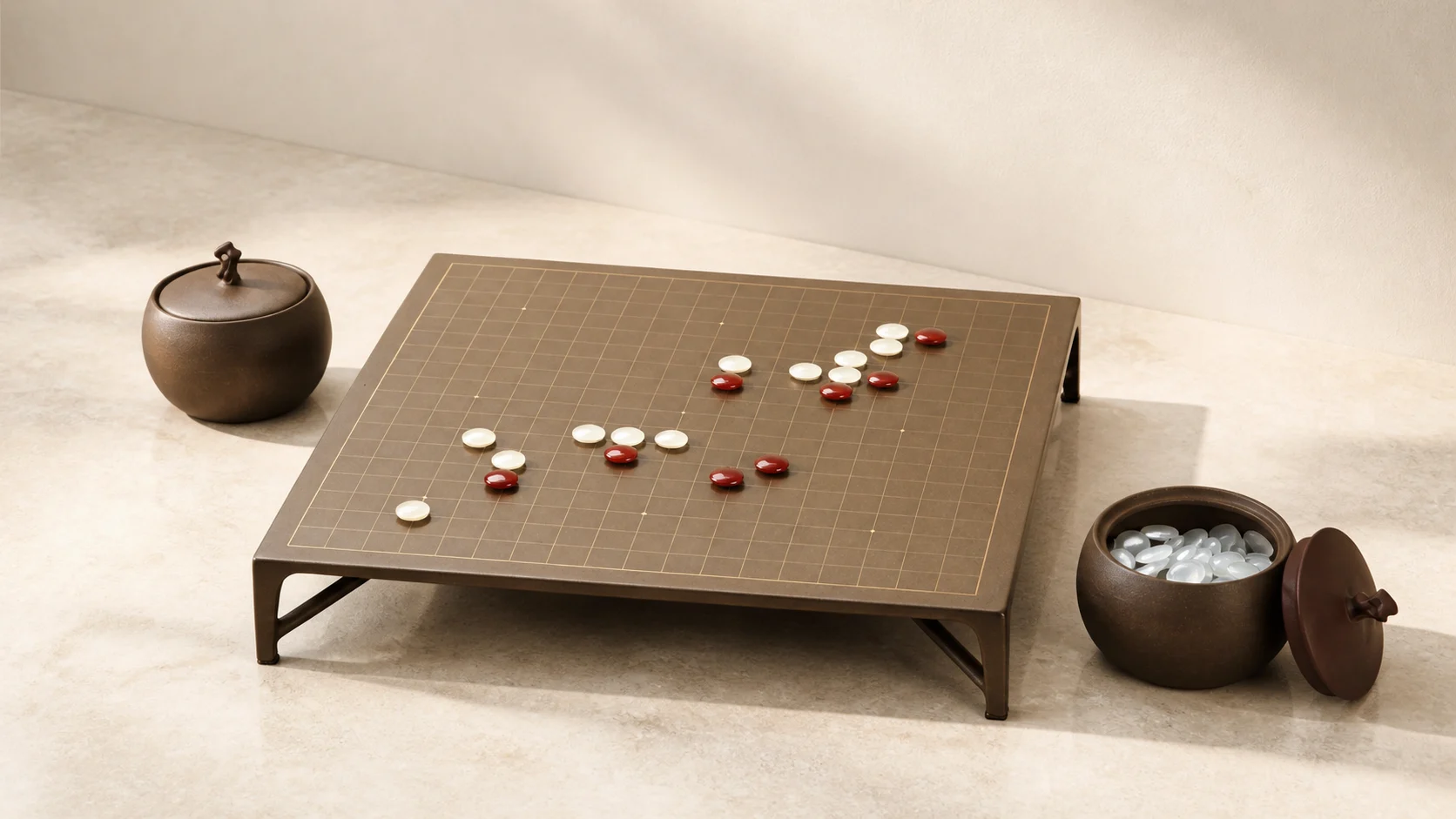
The Da Tian Di Carbon Fiber Go Set applies the same material field to a cultural activity with its own established rules, gestures and storage needs. The board, containers and stones are not merely a decorative scene. They form a system that must support play, setup and return.
This is a recurring characteristic of SHANG XIA’s language: the object is often designed around a sequence. Tea is prepared and poured. A chair receives the body. A Go set opens, orders pieces and closes. Cultural meaning remains tied to use rather than being added only through ornament.
Material contrast creates contemporary distance
One reason these objects avoid straightforward reproduction is the distance created by material contrast. Bamboo meets porcelain. Carbon fibre meets a Ming furniture type. Agate, Zisha and a technically framed board meet the practice of Go.
Distance allows the historical reference to remain visible without pretending that the object belongs to an earlier period. It also exposes the designer’s choice. The viewer can see that a translation has occurred and can ask whether the new material deepens, weakens or redirects the original logic.
That openness is more valuable than a claim of timelessness. It treats modern Chinese design as a continuing argument about what should be preserved, transformed or left behind.
Authorship is broader than a single name
Jiang Qiong’er’s role is central to SHANG XIA’s founding and artistic direction, but a brand of this scope is not the work of one hand. Product development, craft research, engineering, workshops and external collaborators all contribute to the finished objects. Unless an official source assigns a specific product to an individual designer, authorship should not be simplified.
This distinction does not diminish Jiang’s importance. It clarifies it. A founder and artistic director can establish questions, standards and relationships that persist across a collection without personally executing every detail.
A design language built through continuity
SHANG XIA’s language is recognisable not because every object looks alike, but because similar decisions recur: contrast materials rather than blend them invisibly; connect form to ritual; preserve evidence of craft; and let contemporary technology enter without erasing historical structure.
That continuity can support objects as different as tea ware, furniture and games. It also explains why the brand is useful to a broader discussion of modern Chinese design. Cultural identity is not reduced to one motif, colour or material. It is built through the repeated discipline of translation.
What Jiang Qiong’er’s role makes visible
Jiang Qiong’er’s career shows how a designer can work as a cultural editor as well as a form maker. The task is not to declare one final image of “Chinese design.” It is to organise encounters among historical knowledge, current manufacture, artisan skill and international audiences.
The result will always invite debate. Some translations will feel more convincing than others, and cultural inheritance is too varied to be represented by one brand. SHANG XIA’s significance lies in making the process visible at a high level of material and editorial ambition.
This story is based on Jiang Qiong’er’s official biography and SHANG XIA’s current first-party history, craft and product pages checked on 11 August 2026. ChinoMuse did not conduct an interview or studio visit and has not physically tested the featured objects. Inclusion does not imply partnership, sponsorship or endorsement.