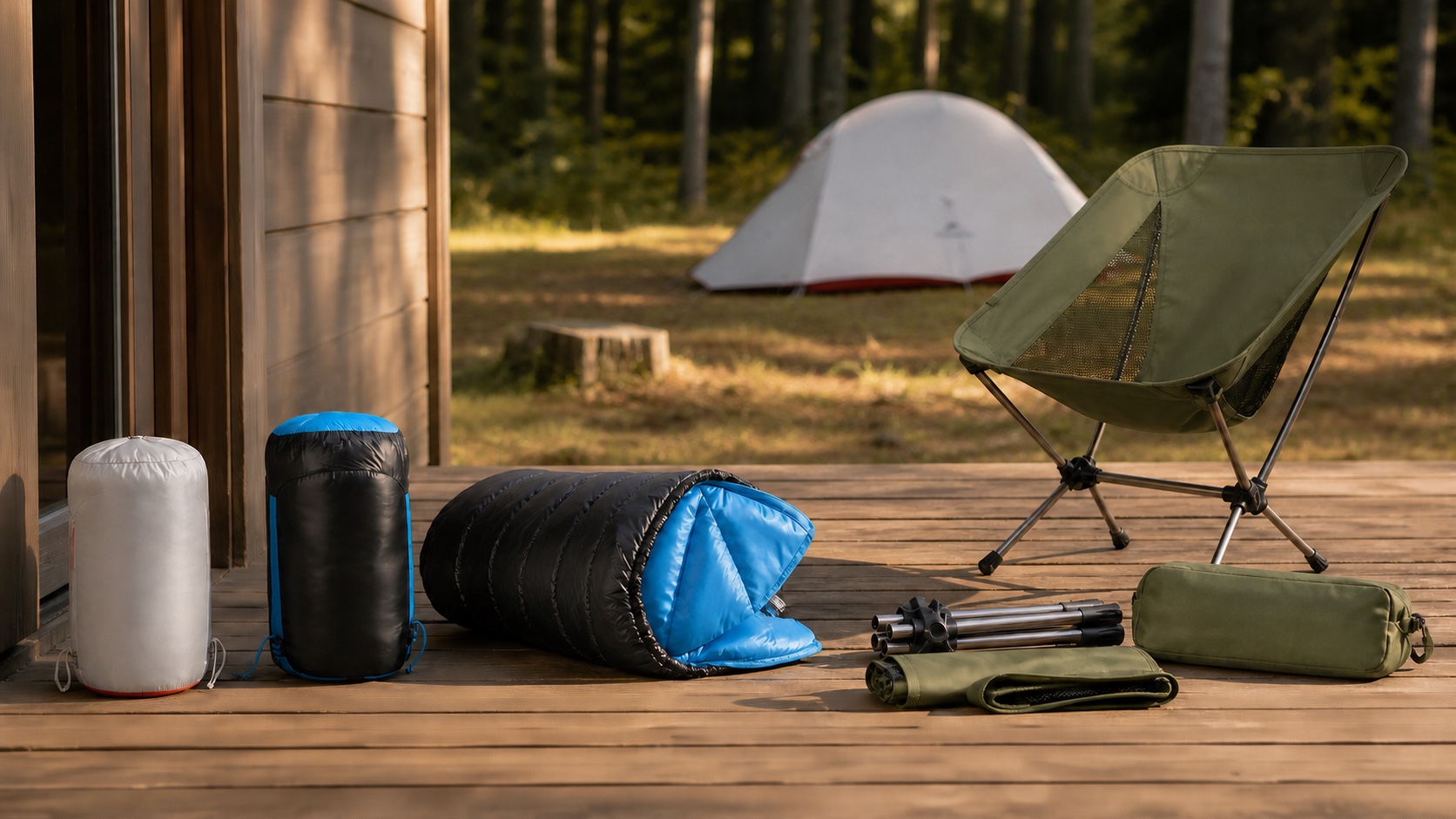


Outdoor equipment is usually photographed in its useful state: a tent standing, a sleeping bag fully lofted, a chair ready to receive a body. Yet much of the design work is devoted to the opposite condition. Before these objects can be used, they have to disappear into a backpack, vehicle, cupboard or railway luggage rack.
Packed size is not an afterthought added when the product is finished. It can determine pole length, fabric choice, frame joints, storage-bag proportions and the order in which an object is assembled. Three current Naturehike records—a tent, sleeping bag and compact chair—make this hidden design brief visible.
The stored object has its own architecture
A packed object is not simply a smaller version of an open one. A tent becomes a bundle of folded textile, pole sections and stakes. A sleeping bag gives up its loft under compression. A chair divides into fabric and a linked frame. Each product needs a second architecture that controls those parts while they are not performing their main task.
This second state affects daily ownership. Equipment may spend far more time dry, stored and waiting than it spends at a campsite. The storage form therefore belongs to the product experience even though it rarely appears as the heroic image.
City storage makes compactness relevant before travel
For an urban owner, the first threshold may be a narrow cupboard rather than a mountain trail. Long components compete with shelves; soft goods need dry, breathable storage; muddy furniture must be separated from clean textiles.
A compact form can make occasional outdoor use easier to accommodate, but compression is not the same as disappearance. Every product still occupies a specific shape, and that shape has to fit domestic storage as well as transport.
The tent is a problem of controlled disassembly
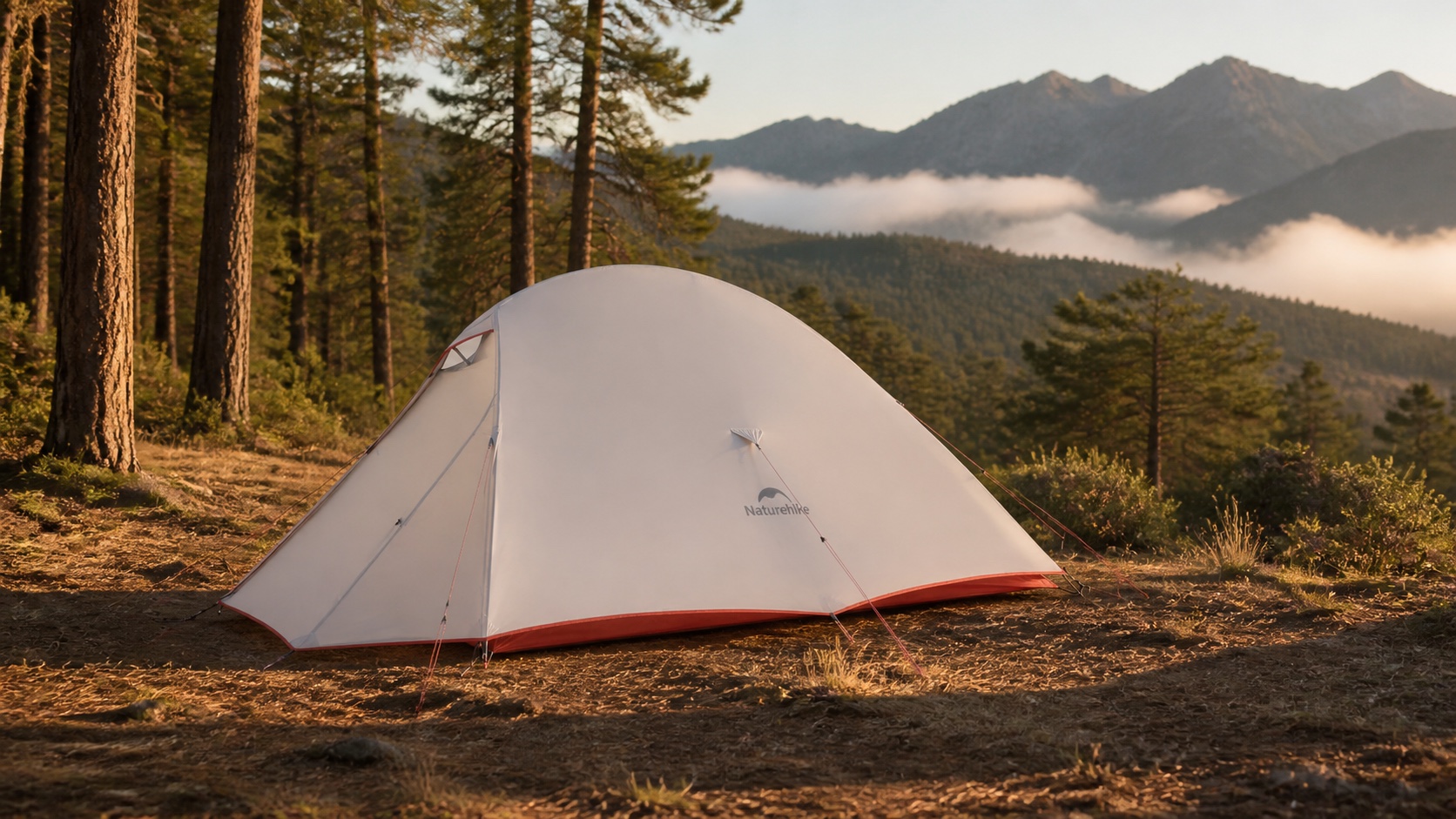
The Naturehike Cloud Up Pro 2 expands to a manufacturer-listed 210 × 130 × 105cm and packs to a 13cm-diameter bundle 40cm long. The change is achieved not by shrinking one rigid object but by separating structural and textile functions.
The pole becomes short linked sections. The fly and floor become folds. Guylines and stakes lose their fixed positions and enter a storage sequence. Compactness depends on each component being easy to identify and recover when the shelter is rebuilt.
Shorter poles create more joints
Reducing packed length often means dividing a frame into more sections. Shock cord can preserve order and guide assembly, but every joint still has to seat correctly. The design gains portability while adding connection points that must remain clean and aligned.
This trade-off appears throughout portable furniture and shelters. The packed dimension is achieved through a choreography of joints, not through a free reduction in material.
The sleeping bag compresses rather than dismantles
The CWM 400 uses another route. Its soft shell and down insulation can be compressed into a listed 35 × 18 × 18cm storage form. No pole is removed and no platform folded, but the material changes volume dramatically.
That ability introduces a distinction between transport and long-term storage. Compression helps a bag travel; insulation generally needs space to recover between journeys. A design that packs efficiently still asks the owner to understand when the compact state should end.
Loft turns volume into function
For an insulated object, the open volume is not wasted space. It is part of the thermal structure. Down creates still air only when it can loft, so the journey from pouch to sleeping form is a functional transformation rather than a cosmetic one.
This makes packed size an incomplete measure on its own. A small bundle is useful only if the material can recover and the opened dimensions suit the user. Storage efficiency and operating performance remain connected but distinct.
The chair divides structure from surface
The PeakLite YL08 separates its load-bearing frame from its fabric seat. Naturehike lists a storage bag measuring 50 × 13 × 14cm, a 7075 aluminium frame and a 55cm seat.
When packed, the frame becomes a bundle of narrow tubes and the seat becomes a folded surface. When assembled, tension between them creates the chair. Neither part is complete alone; compactness comes from postponing that relationship until the destination.
Assembly is the cost of a smaller object
A folding system moves work from the factory-set form to the user. Pole ends must find their sockets, fabric corners must stretch into place and feet must sit on suitable ground. Naturehike states an under-60-second setup for the cited chair, but the more revealing fact is that setup exists at all.
Portable design asks how much assembly is acceptable and how errors can be prevented. Shock cord, consistent tube ends and a legible geometry reduce uncertainty. The better the packed object communicates its next state, the less compactness feels like a puzzle.
Packed dimensions influence transport behaviour
Length, diameter and rigidity decide where equipment can sit. A 50cm chair bundle may fit beside a backpack frame but not across a small day bag. A 40cm tent package may sit horizontally in one pack and vertically in another. A soft sleeping bag can fill a gap, though excessive pressure has consequences for its insulation.
These are not merely logistics after design. Storage-bag geometry shapes how the product meets other objects and how the total system balances on the body.
Compact does not always mean light
Small volume and low mass are often presented together, but they describe different properties. Dense hardware can pack neatly while remaining heavy. A low-density textile can be light but bulky. More joints may reduce length while adding connectors.
A useful record keeps weight and packed dimensions separate. The chair’s listed 0.96kg, the tent’s packed 1.53kg and the sleeping bag’s 0.9kg say nothing by themselves about where each shape fits.
The three objects form one storage system
Seen together, the products create a small study in transformation. The tent disassembles, the bag compresses and the chair separates. Each uses a different material logic to move between domestic storage, transport and outdoor use.
The owner must coordinate those transformations: dry the tent, release the sleeping bag from compression, keep the chair fabric and frame together, then reverse the process before departure. Product design and routine become inseparable.
What the records can establish
Official pages can establish published dimensions, named materials, product identity and the manufacturer’s described assembly. They cannot establish how easily every owner packs the product, how quickly materials wear or whether one system feels comfortable after a long approach.
Those limits matter because compactness is experienced through repetition. A storage pouch that works in a studio photograph may behave differently when damp, cold or hurried. Without physical use, those outcomes should remain open questions.
Designing the transition, not only the object
The significance of packed size is not that outdoor equipment is vanishing. It is that products are being designed around orderly changes of state. A useful compact object explains how it closes, where its pieces belong and how it becomes trustworthy again when opened.
That is a broader lesson in portable design. The object at rest, the object in motion and the object in use are all real versions of the product. Packed size matters because it connects them.
Editorial scope
This independent story is based on Naturehike’s public brand and product information checked on 13 August 2026. ChinoMuse did not interview the company and has not physically used, packed or tested the featured equipment. Dimensions, materials, ratings and setup statements remain attributed to Naturehike. Inclusion does not imply partnership, sponsorship or endorsement.


