A watch normally hides its work behind a dial. The hands move, the case frames them and the mechanism remains a private explanation. Some contemporary Chinese watches reverse that order. The movement, display and case become the first things the eye reads.
CIGA design’s Gorilla and Blue Planet II make that shift in very different ways. Gorilla exposes an angular mechanical architecture inside a square case. Blue Planet II turns the display into a rotating globe-like composition. Neither object is discussed here as a performance review; ChinoMuse has not tested accuracy, comfort, water resistance or durability.
The dial stops being a neutral background
On a conventional watch, the dial organises familiar elements: hour markers around an edge, hands from a centre and information in smaller fields. It can be decorative, but it also behaves like a standard page.
When that page disappears, every structural decision becomes part of legibility. Bridges, gears, scales and empty space have to explain where the eye should begin. The watch is no longer a case containing a display; the entire case becomes the display.
Gorilla makes the mechanism architectural
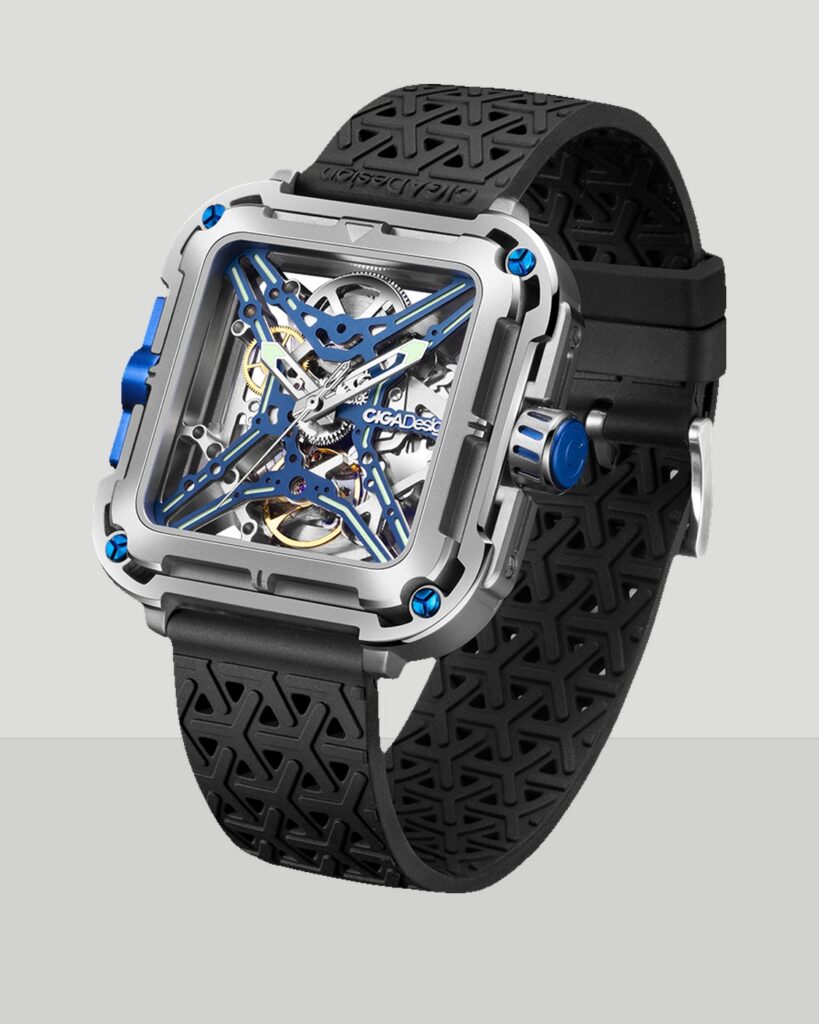
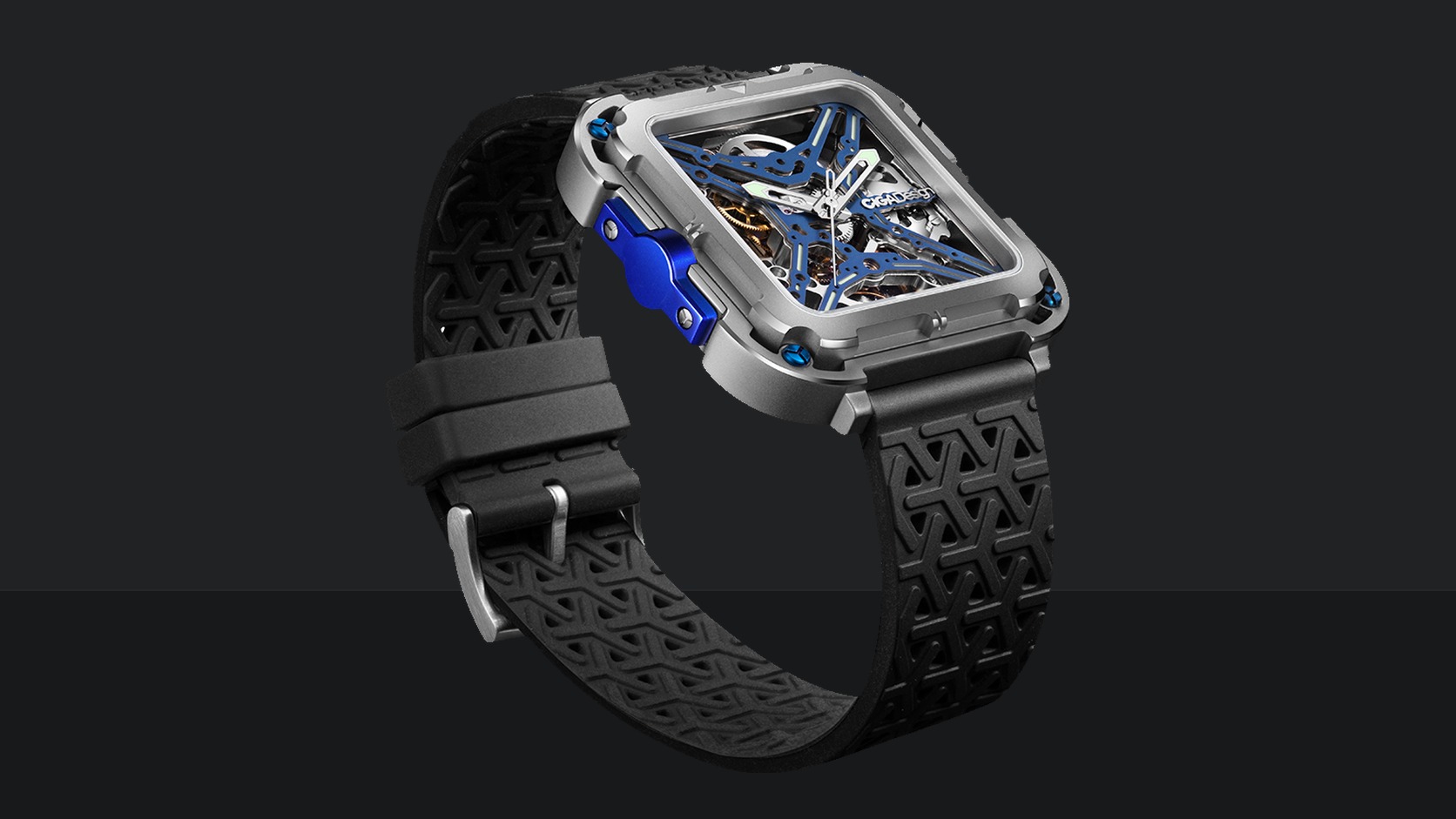
The CIGA design Mechanical Watch Gorilla belongs to the X Series. Its cited official pages describe an open-worked mechanical architecture, an X-form composition, a double-layer case and a four-corner suspension concept.
The visual result is angular rather than ornamental. Blue structural members cross the visible mechanism while the rectangular case establishes a frame more like a small engineered object than a traditional round dial.
The case becomes a piece of visual evidence
Open construction lets a viewer see that the object contains layers, moving parts and points of attachment. It does not prove accuracy, shock resistance or long-term serviceability. Visibility is evidence of arrangement, not performance.
This distinction matters because technical appearance can easily become a marketing shortcut. Gorilla’s exposed structure is meaningful as design: the way it composes movement, case and strap. Any functional claim still needs an exact specification and the correct regional listing.
Blue Planet II changes how time is read
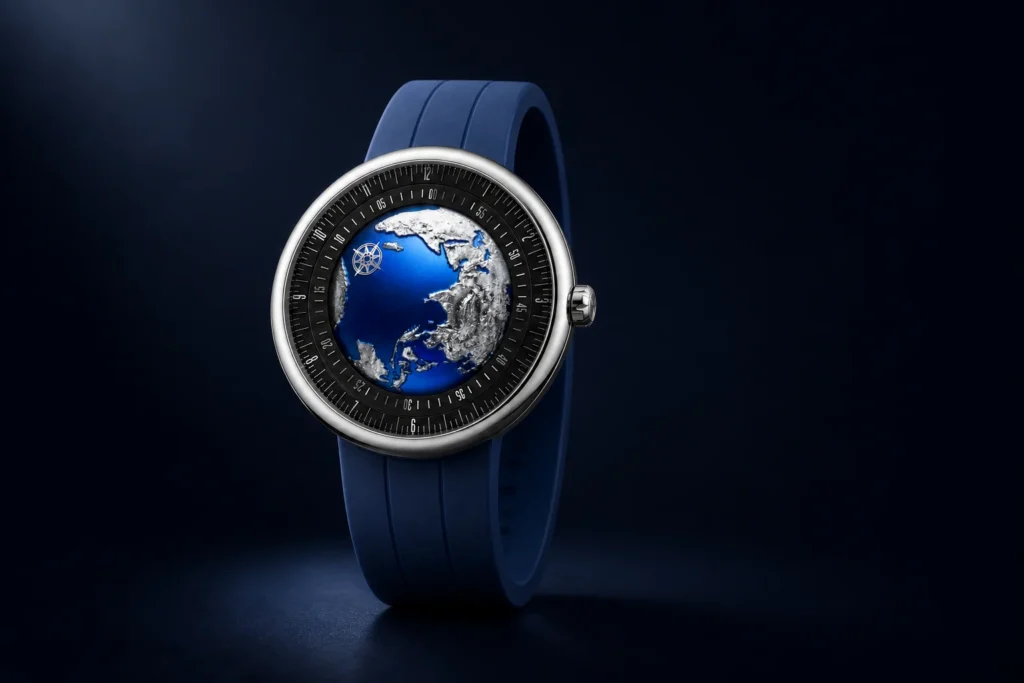
The CIGA design Blue Planet II takes a different route. Its globe-like centre and asynchronous hour-minute display replace the familiar relationship between two hands and a fixed dial.
Here the mechanism is visible through movement of the whole composition. The display makes the idea of a planet more than a surface graphic. Form and reading method are joined, so learning how to read the watch is part of encountering its identity.
Award context belongs to the exact record
The original Blue Planet received the 2021 Challenge Watch Prize from the Grand Prix d’Horlogerie de Genève. That verified award establishes context for the design lineage; it should not be transferred automatically to every later Blue Planet variant or to Gorilla.
Precise attribution protects the story. It allows an award to explain why a design became visible internationally without turning it into a blanket endorsement of an entire range.
One brand, two kinds of visibility
Gorilla makes internal architecture visible. Blue Planet II makes the act of displaying time visible. The first emphasises layers, supports and an angular frame. The second emphasises a central image and an unconventional reading sequence.
Together they show why a brand profile should not be reduced to one hero product. A visual language can be coherent because it treats the watch as a complete object, even when the resulting forms look markedly different.
Legibility becomes part of the design argument
Unconventional display creates attention, but attention is not the same as immediate reading. A wearer may need to learn where hours and minutes sit, how reflections affect the view and whether the composition remains clear at a glance.
That learning curve is not automatically a flaw. It is a design decision with consequences. A prospective buyer should compare the desire for a distinctive interface with the situations in which rapid reading matters.
Visible mechanics carry emotional meaning
A mechanical watch is partly valued because its operation can be imagined even when hidden. Opening the structure turns that imagination into a visible event. Gears and bridges create motion at a scale small enough to reward close attention.
For Gorilla, the visible mechanism supports an engineered, contemporary character. For Blue Planet II, movement supports a more symbolic picture of time and rotation. In both, mechanics carry meaning beyond the measurement of hours.
Photography has to preserve the complete object
These watches are especially sensitive to cropping and contrast. Cutting a strap or case corner can remove the relationship between frame and movement. A bright extraction halo can make the object look detached from its setting and misrepresent the precision of the edge.
ChinoMuse therefore uses dedicated article and archive images with the complete watch visible, appropriate breathing room and recorded first-party sources. The image presents the design; it does not imply ownership, partnership or physical testing.
Regional listings still need verification
Model names, case materials, strap combinations, package contents and availability can vary between storefronts. Gorilla’s cited regional listing shows silicone and nylon straps, but the active listing should be checked for the selected variant and destination.
Before purchase, confirm current dimensions, movement, water-resistance statement, warranty, service route, returns and included accessories. A design story can explain the object; it cannot replace the current transaction record.
Chinese watch design as object design
The most revealing feature of these two watches is not that they look unusual. It is that they make the organization of time, movement and case inseparable. The watch is conceived as a designed object rather than a familiar dial with a new decoration.
That approach places Chinese mechanical-watch design within a wider field of contemporary product design. It asks how an object communicates its operation, how identity emerges from structure and how much interpretation the user is invited to perform.
Making time visible
Gorilla exposes a mechanical architecture; Blue Planet II reorganises the act of reading. Their difference is the point. Both make time visible by giving the mechanism and display a physical presence that cannot be separated from the case around them.