

PETKIT’s current catalogue can be read as three domestic routes: food, water and litter. Each begins with a familiar object—a hopper, a reservoir, an enclosed tray—but extends into sensors, wireless connections, records and consumables. The physical product is no longer the whole proposition. It is the point where a recurring household task meets an app.
That shift is visible in three representative products: YumShare Dual-hopper 2, EverSweet Max 2 (UVC) and Purobot Max Pro 2. Together they show how PETKIT has moved beyond standalone automation towards connected pet care. They also show why automation does not remove maintenance or human judgement.
From a schedule to a visible feeding event
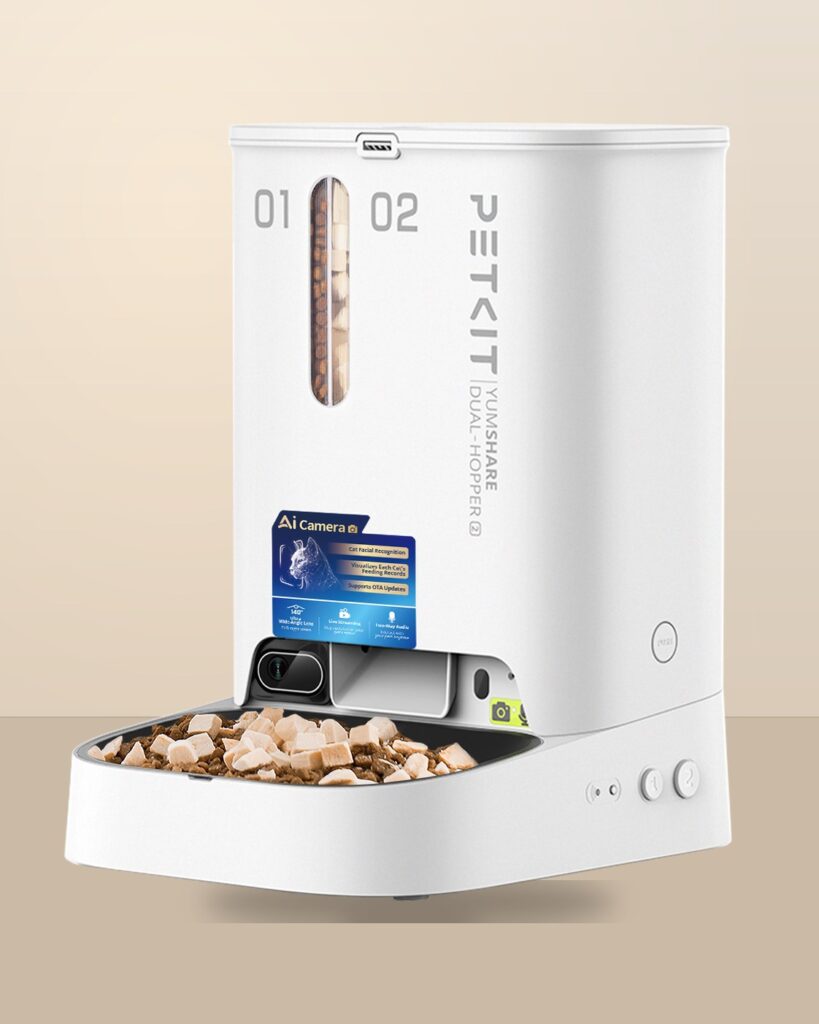
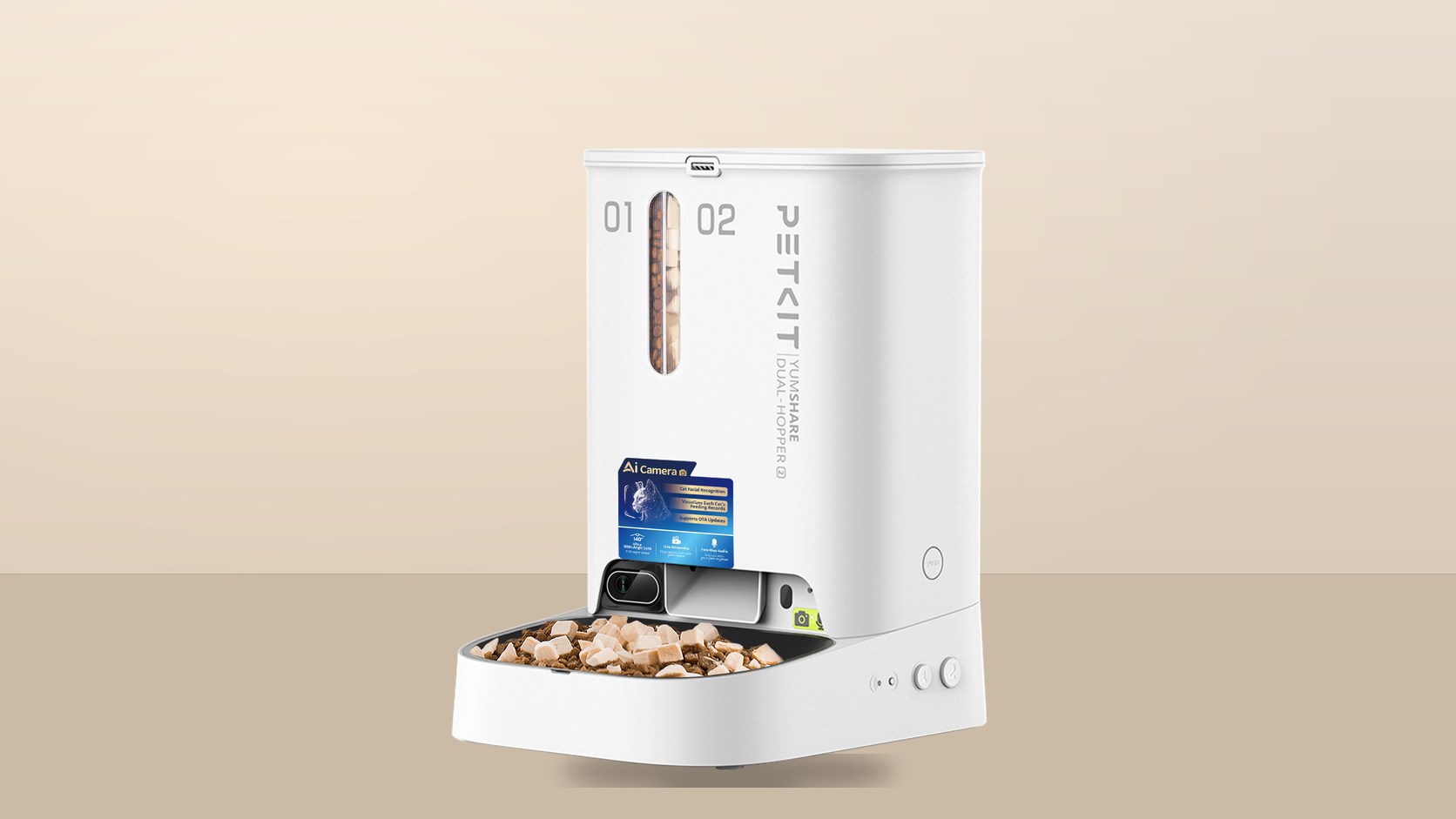
An automatic feeder once meant a timer and a motor. The YumShare Dual-hopper 2 adds two separate hoppers, a camera, app records and two-way audio. Its 5L volume is divided between 2L and 3L compartments, allowing two compatible dry foods to remain separate until dispensing.
The design interest lies in the join between storage and observation. The camera is positioned above the bowl, where it can create a visual record around dispensing. Yet the record is conditional. Normal camera operation depends on external power, network access and service availability. On four D-cell backup power, the cited manual allows limited scheduled dispensing but switches the camera off.
This is the first recurring PETKIT pattern: a core mechanical task can continue in a reduced state while the connected layer disappears. The distinction matters more than a general claim that the feeder is “smart.”
Two hoppers turn storage into a design decision
Dividing the food container changes how the feeder is filled and cleaned. It can keep two compatible dry foods apart, but it also gives the user two paths to inspect for low food, unsuitable piece size or blockage. PETKIT identifies maximum sizes for kibble and freeze-dried pieces. Those limits are engineering boundaries, not dietary recommendations.
The feeder therefore links three kinds of information: the schedule stored by the system, the camera view and the direct evidence available to the person who refills and cleans it. None is complete alone. A dispensing record cannot prove that an animal ate, and an image cannot establish nutrition or health.
Hydration changes the relationship with power
The EverSweet Max 2 (UVC) takes a different approach. Its 3L reservoir, stainless steel drinking tray and wireless pump separate the water container from an exposed pump lead. A built-in battery supports cordless placement, while the cited manual describes standard, intermittent and motion-sensing modes.
Cordless placement is not just a convenience feature. It changes where the object can sit and how it is carried to a sink. The water container can be lifted away, but the user still needs to recharge the product, keep connections dry, replace filters and clean the water path. The pump, filter and battery form a maintenance chain behind the quiet white enclosure.
Why a water record is not water care
PETKIT promotes app records and a wireless UVC pump. These may help the user track the device’s operation, but they do not make water quality self-verifying. Source water, filter condition, temperature, residue and cleaning frequency remain outside what an app status can fully establish.
The difference between a device record and an animal outcome is especially important here. A fountain can log operation or estimated interaction without proving adequate intake. Direct observation and routine cleaning remain part of the product experience even when the interface suggests continuity.
The litter box makes the enclosure a sensing space
Purobot Max Pro 2 brings the most complex combination of mechanics and records. The automatic litter box combines a 76L rotating cylinder, an 8L waste bin, weight sensing, Wi-Fi and a fixed 1080p camera. The entrance, camera angle and internal screen turn the enclosure into both a waste-handling mechanism and a place where visits are recorded.
The physical scale is substantial: PETKIT lists the body at 657 × 538 × 603mm and the entrance at 255mm. It requires a hard, level floor and clearance from the wall. Unlike a small app accessory, the product reorganises part of a room. The space needed to remove waste, clean surfaces and approach the entrance is part of its design footprint.
Automation concentrates maintenance rather than eliminating it
The rotating cylinder moves waste towards a bin, but the bin still needs liners and emptying. Sensors need a stable floor. The camera window, screen and surrounding surfaces need inspection. Compatible litter and cat-weight limits remain relevant. PETKIT’s estimate for waste-bin duration is conditional; the actual interval changes with the number of cats, litter, humidity and household routine.
Across all three products, automation moves repetitive actions into less frequent maintenance sessions. Food is stored and dispensed, water is circulated and filtered, litter is separated and contained. The work becomes refill, cleaning, charging, consumable replacement and exception handling.
A common visual language across unlike objects
PETKIT uses pale enclosures, softened rectangular forms and clearly separated service areas. The products are meant to sit in domestic interiors rather than look like industrial equipment. Dark openings, camera modules and water surfaces signal the active zones, while removable containers and doors indicate where the user intervenes.
This shared language connects products of very different size. The feeder and fountain can occupy a small feeding corner; the litter box needs its own floor area. Their resemblance comes less from identical shapes than from a consistent effort to make technical components appear calm and approachable.
The app is a second product surface
Schedules, alerts, camera views and histories give the app a role comparable to the physical control panel. It can bring separate devices into one account and make events visible when the user is elsewhere. That layer also creates dependencies: account access, network conditions, phone permissions, cloud policies and optional subscriptions.
The app should not be mistaken for the product’s only interface. Each object still has buttons, indicators, openings and removable parts. A resilient routine depends on understanding those physical cues and the reduced behaviour available when the connected layer is unavailable.
Connected care produces more data—and more interpretation
A meal image, a fountain status or a litter-box visit can be useful context. But the more a product records, the more carefully the record must be interpreted. Classification may be incomplete, pets may share devices, sensors may be affected by placement and cloud functions may change.
PETKIT’s products illustrate a wider design issue: consumer hardware increasingly presents activity as a timeline. A timeline is not a diagnosis. It may help a person notice a change, but it cannot decide what the change means or replace professional veterinary assessment.
Consumables keep the system tied to the brand
Filters, liners and other model-specific parts extend the relationship beyond the original purchase. They also determine how long the routine remains convenient. A product can be mechanically sound while becoming difficult to maintain if the correct consumable is unavailable in the buyer’s region.
For this reason, PETKIT’s international storefronts and service channels are part of the design story. Product pages need to be read alongside regional warranty, app and accessory availability. The connected layer may travel across borders more easily than a replacement pump, filter or liner.
Three products, three different failure states
The feeder can lose its camera while retaining limited scheduled dispensing on backup cells. The fountain can lose cordless operation when its battery is depleted, while water still needs direct checking. The litter box can require manual intervention when placement, litter or waste conditions fall outside normal operation.
These reduced states reveal the real boundaries of connected care. The important question is not whether a product automates a routine on a normal day. It is whether the household understands what remains when power, network, consumables or maintenance are interrupted.
What PETKIT’s range says about contemporary hardware
PETKIT was founded in 2013, according to its official history. Its current products reflect a decade in which sensors, cameras and apps have moved into ordinary domestic objects. Feeding, drinking and litter care are repetitive enough to benefit from automation, but sensitive enough that the result cannot be judged by convenience alone.
The strongest part of the range is not any single headline feature. It is the attempt to coordinate storage, movement, sensing and records around tasks that recur every day. The limit is equally clear: an automated object can support care, but it cannot take responsibility for an animal.
Editorial scope
This story is based on PETKIT’s official brand history, current product pages and cited manuals checked on 16 August 2026. ChinoMuse has not physically tested the products, observed animals using them, audited algorithms or cloud systems, or verified health and performance claims. Regional models, subscriptions, accessories and services may change.