


A label maker sits quietly until a drawer becomes impossible to understand. Then the machine appears to offer a simple cure: print a word, attach it to a container and restore order. But the printed word is only the visible edge of a larger system.
The system begins before the printer. Someone decides that two things belong together, that a shelf needs a name or that a cable should be recognised without tracing it to the wall. Classification comes first. The printer gives that decision a durable, repeatable shape.
The smallest machine changes the location of writing
NIIMBOT’s D110_M reduces the physical printer to a 98 × 76 × 30mm body weighing 149g. There is no built-in keyboard and no large display. The act of writing moves to a phone, while the device concentrates on feeding and printing narrow labels.
That division is characteristic of contemporary small hardware. A simple object on the desk can depend on a much larger software environment: operating-system support, an application store, fonts, templates, Bluetooth permission and an account region. The printer looks self-contained. The workflow is not.
Width changes what can be said
B21 Pro accepts labels up to 50mm wide and prints within 48mm at 300dpi. Compared with D110_M’s 12mm effective width, the difference is not only size. A wider field allows hierarchy: a heading, a date, a barcode, an icon or several lines can occupy the same object.
More space also creates more decisions. The person making the label must decide what deserves emphasis, what can be abbreviated and how the result will be read. A storage label seen from across a room is not designed like a small cable identifier. The printer becomes a tool for information design.
A change of print method changes the object
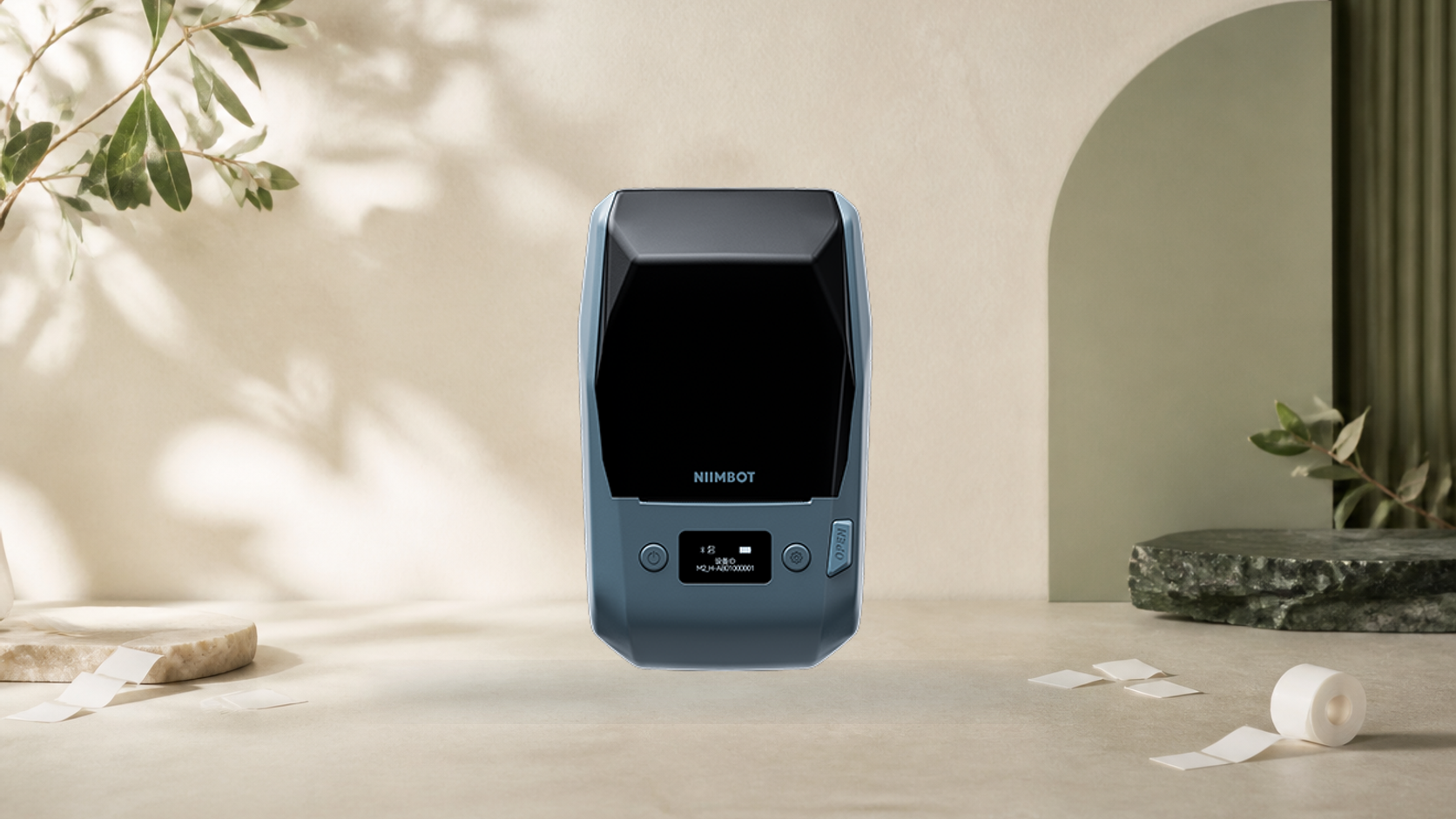
M2_H looks like the larger professional member of the family, but its important difference is internal. It uses thermal transfer rather than direct thermal printing. A ribbon becomes part of the material path, and the label is no longer defined by heat-sensitive stock alone.
That change makes material selection more explicit. Ribbon, label coating, adhesive, surface and environment must work together. Manufacturer longevity claims can indicate an intended direction, but they cannot replace a record of heat, ultraviolet exposure, abrasion, chemicals or storage conditions.
The label is a promise to a future reader
A label is written in the present for someone who will encounter the object later. Sometimes that reader is the same person after memory has faded. Sometimes it is a colleague, family member or technician who never saw the original arrangement.
This is why useful labels need context rather than decoration. “Cable” says little. “Monitor USB-C — desk left” may prevent a mistake. A date can explain whether a container should still be used. A version number can separate an active part from an obsolete one. The value lies in the decision encoded, not in the act of printing.
Organisation can create clutter of its own
The promise of perfect order can lead to too many categories, too many label styles and too much maintenance. A drawer becomes a catalogue that nobody updates. The printer remains ready, but the classification has lost contact with daily use.
A restrained system starts with repeated confusion. Label the place where the same question occurs twice. Use language that another person can understand. Avoid a special code when ordinary words work. Remove a label when the category no longer exists.
Hardware reveals the scale of the problem
D110_M, B21 Pro and M2_H are not a progression in which the largest is automatically best. They reveal three scales of the same activity. The narrow machine handles short identifiers. The wider direct-thermal machine makes more complex layouts practical. The thermal-transfer machine changes the consumable system when the application calls for it.
Choosing between them therefore begins with the record to be made: how much information, how often it changes, where the label will live and who must read it. Resolution, width, sensing and software matter because they support that record.
The printer is the middle, not the beginning
The beginning is a decision about what matters. The middle is a system that turns the decision into a physical mark. The end is a future moment when the mark prevents uncertainty. Seen this way, a label maker is more than a printer because printing is only one step in making objects legible.
This story is based on current first-party NIIMBOT brand, product and solution pages checked on 9 August 2026. ChinoMuse has not physically used the machines or assessed their applications, labels, battery life or long-term output. The three products are presented as distinct design approaches, not as a performance ranking.


