A paper umbrella, a lantern frame and a broken ceramic fragment do not look like the beginning of the same furniture practice. One is built around a thin skin, another around a fine framework, and the third appears to be material left after another object has failed. PINWU connects them through a method: study how a craft organises material, separate that logic from its familiar object and test it again in a contemporary form.
The Hangzhou studio calls this direction “Future Tradition”. Its public record describes research into Chinese handicrafts and materials rather than the reproduction of historical style. Three furniture works—Piao II, GU and CEWO—show how that position changes across a decade. This story is based on PINWU’s official archive. ChinoMuse has not visited the studio, interviewed the designers or physically assessed the chairs.
A studio built around deconstruction
PINWU’s official profile names Zhang Lei, Jovana Zhang and Christoph John as the founding designers. It describes a practice spanning furniture, products, installations, spaces, exhibitions and visual communication, tied together by the deconstruction of traditional handicrafts and materials. The important word is not tradition alone but deconstruction: the studio looks for a process that can move.
This creates a different relationship with heritage. A chair does not need to resemble an umbrella or lantern. Instead, it can borrow the way paper is layered over a form or the way a light bamboo network supports a surface. Recognition shifts from motif to construction.
Yuhang becomes a place of material research
The founders’ official biographies connect the practice with Yuhang, Hangzhou, where they began deeper research into local handicrafts in 2010. PINWU’s Chinese profile also describes the later Róng Design Library as a non-profit library for traditional craft materials and processes. The archive positions research as something gathered, organised and made available for new design work.
That context matters because material translation depends on more than an isolated studio experiment. Bamboo paper, dyeing, paper umbrellas and lantern making belong to chains of tools, skills and local knowledge. PINWU’s furniture extracts particular structural ideas from those chains while still naming their origins.
Piao begins with the logic of a paper umbrella
The earlier Piao chair established a paper-shell approach. PINWU’s account connects its layered construction with the craft of covering an oil-paper umbrella: sheets are applied over a supporting form until they become a continuous skin. In furniture, the operation changes in scale and purpose, but the principle of building strength through repeated layers remains legible.
This is not evidence that every paper object behaves alike. Paper type, fibre direction, adhesive, number of layers and mould geometry all affect the result. The significance of the umbrella reference is procedural. It provides a way to think about how a flexible sheet can become a three-dimensional shell.
Piao II adds the intelligence of a lantern frame
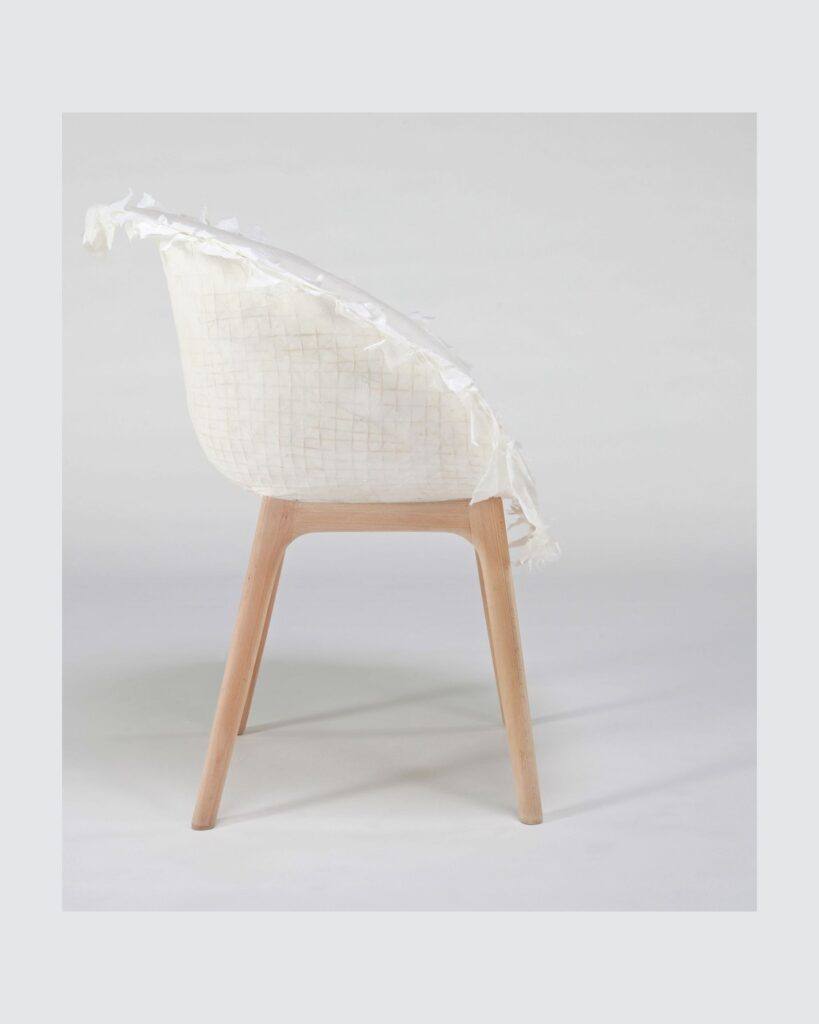
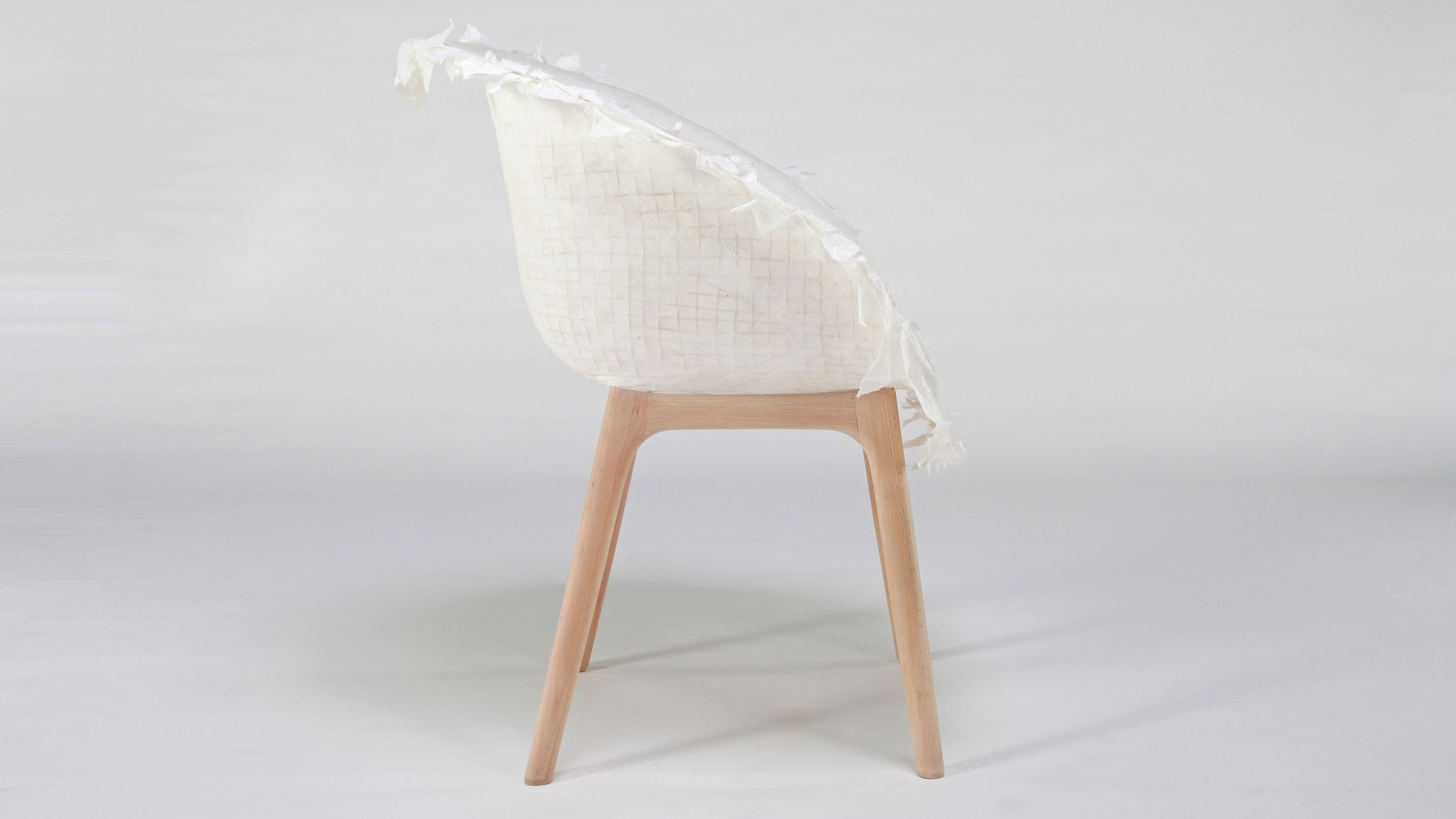
The Piao II chair, dated 2013, develops that research by combining bark paper, beech and fine bamboo filaments. PINWU connects the bamboo network with traditional lantern making. A fine grid works with the paper, allowing the shell to become thinner than the earlier layered approach described in the archive.
The visible edge makes the transfer easier to read. Paper fibres and the underlying network are not completely sealed behind upholstery or trim. The chair therefore presents construction as part of its identity: the object asks the viewer to notice how a lightweight surface gains form.
The framework changes what paper can do
A lantern frame is valuable here not because it carries a nostalgic image, but because it distributes support with little material. When that logic enters a seat shell, paper and bamboo are considered together. The shell is not simply paper placed over a conventional hidden chair; the network participates in the visible material argument.
Photographs establish the fine grid and irregular edge, but not load capacity, stiffness, humidity response or comfort. Those limits matter. A design story can explain the transfer of craft logic without converting it into a performance guarantee.
GU moves from bamboo fibre to a moulded body
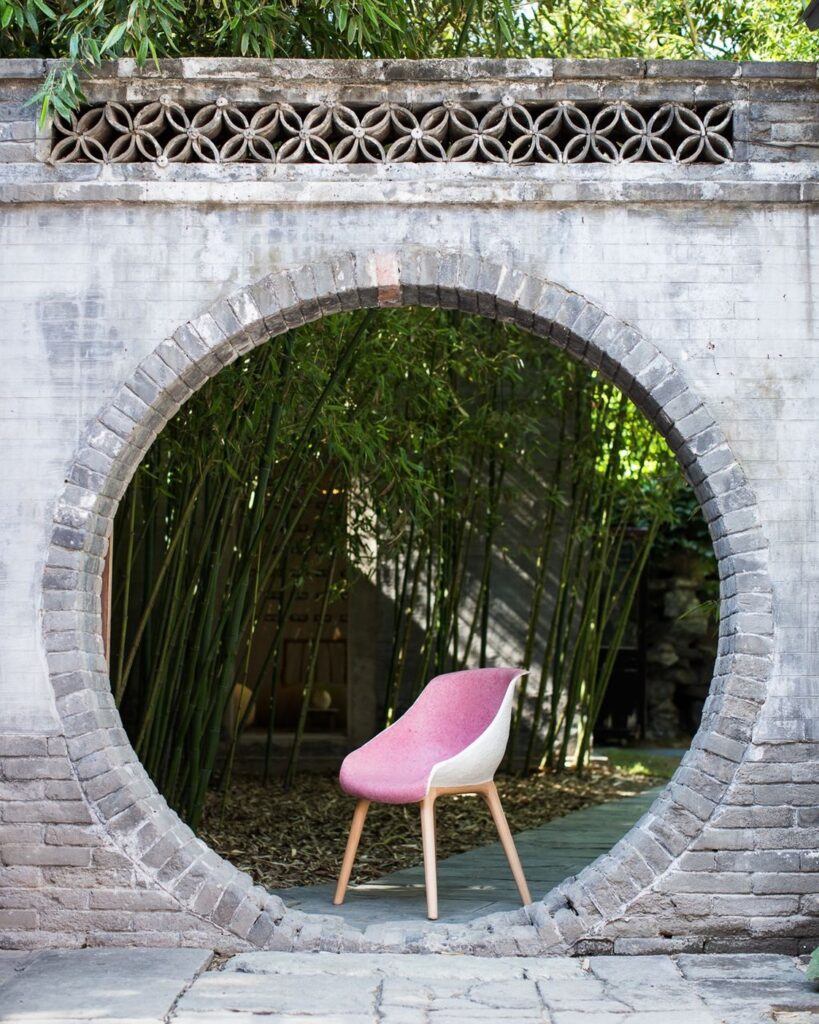
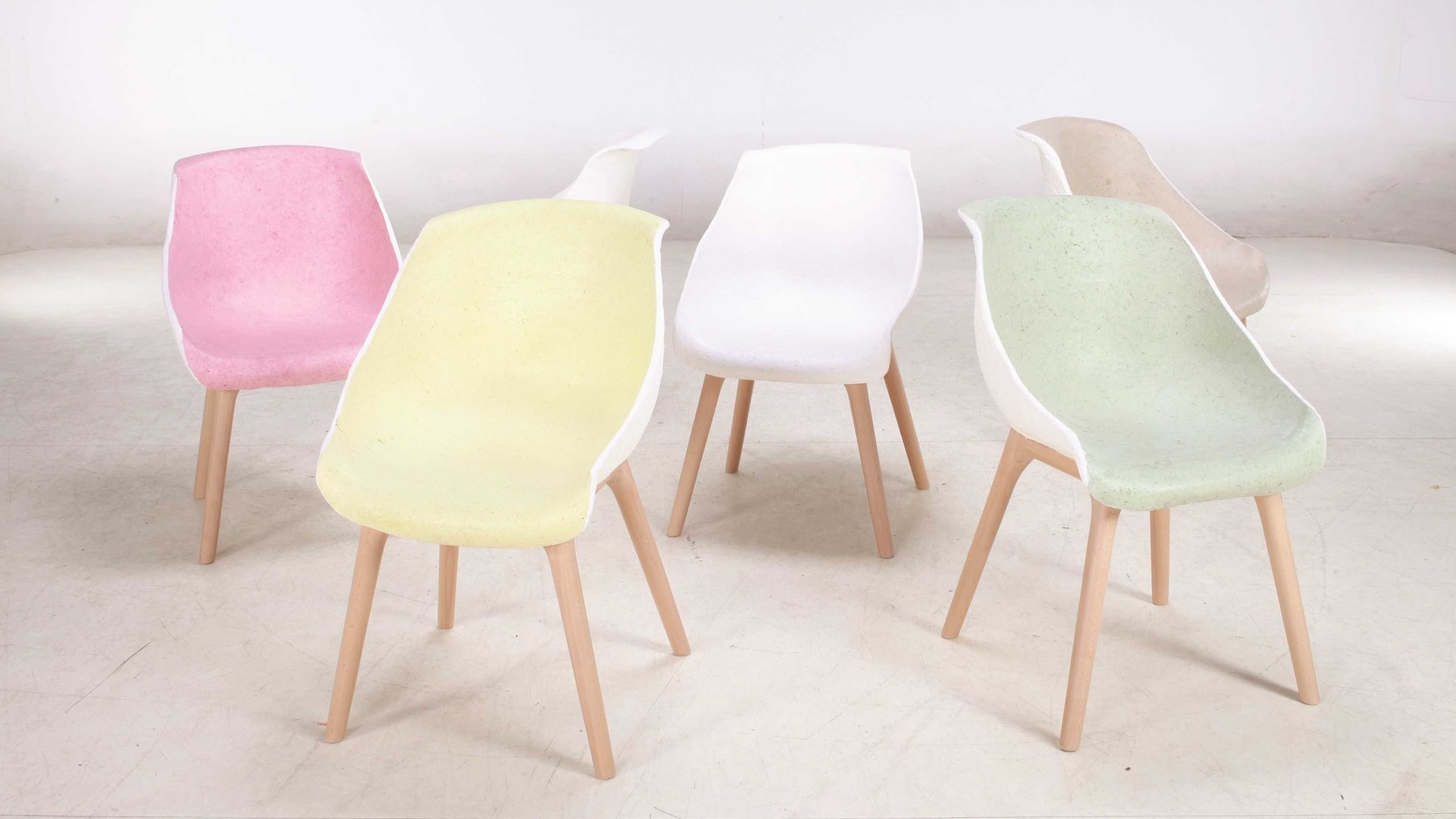
The GU chair, also dated 2013, follows another route. PINWU’s record describes bamboo moving through fibre and paper production before becoming a paper-pulp shell. Instead of keeping recognisable sheets, GU forms a continuous moulded body supported by light wooden legs.
The shift from sheet to pulp changes the visual evidence. Fibres remain visible across the surface, while the rim and curved body show how the material has been shaped. The chair makes a process normally associated with paper production occupy the scale of furniture.
Dyeing becomes part of the material experiment
GU appears in pale pink, yellow, green, white and natural-toned versions. The official page links this variation with traditional dyeing research. Colour is therefore not merely a later styling layer in the public story; it belongs to the studio’s investigation of how the paper material can be transformed and read.
The photographs do not establish current finish availability or exact colour matching. They do show that variation is part of the research language. Surface, fibre and colour remain close enough that the shell does not imitate a uniform plastic moulding.
CEWO begins after another object has broken
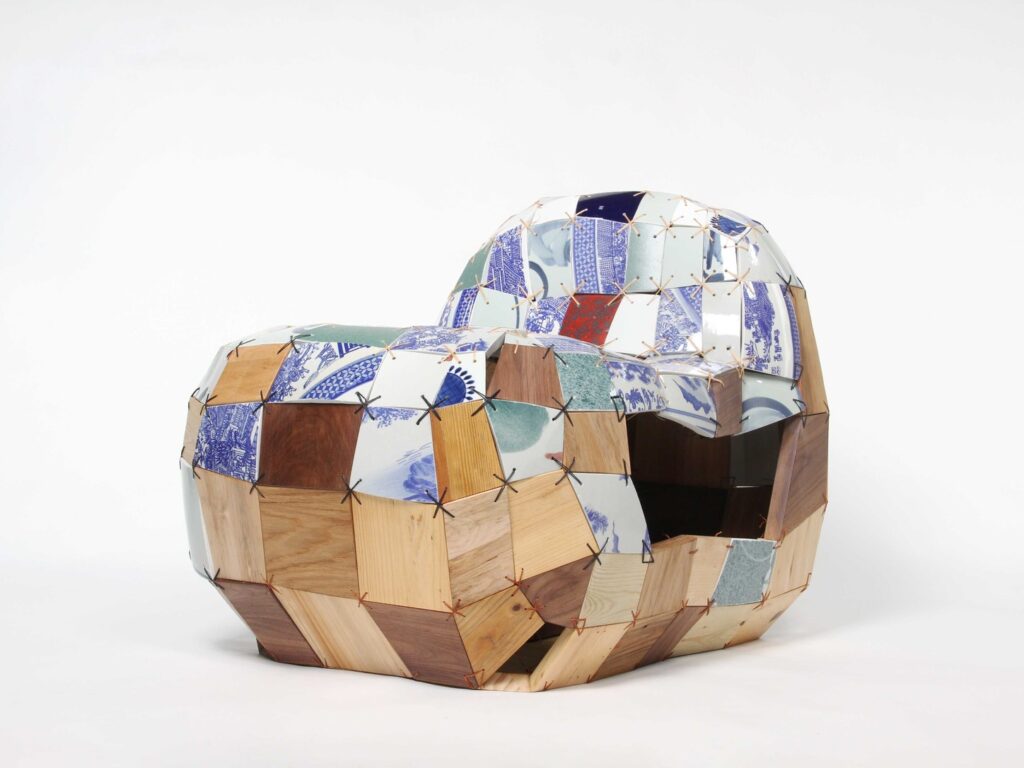
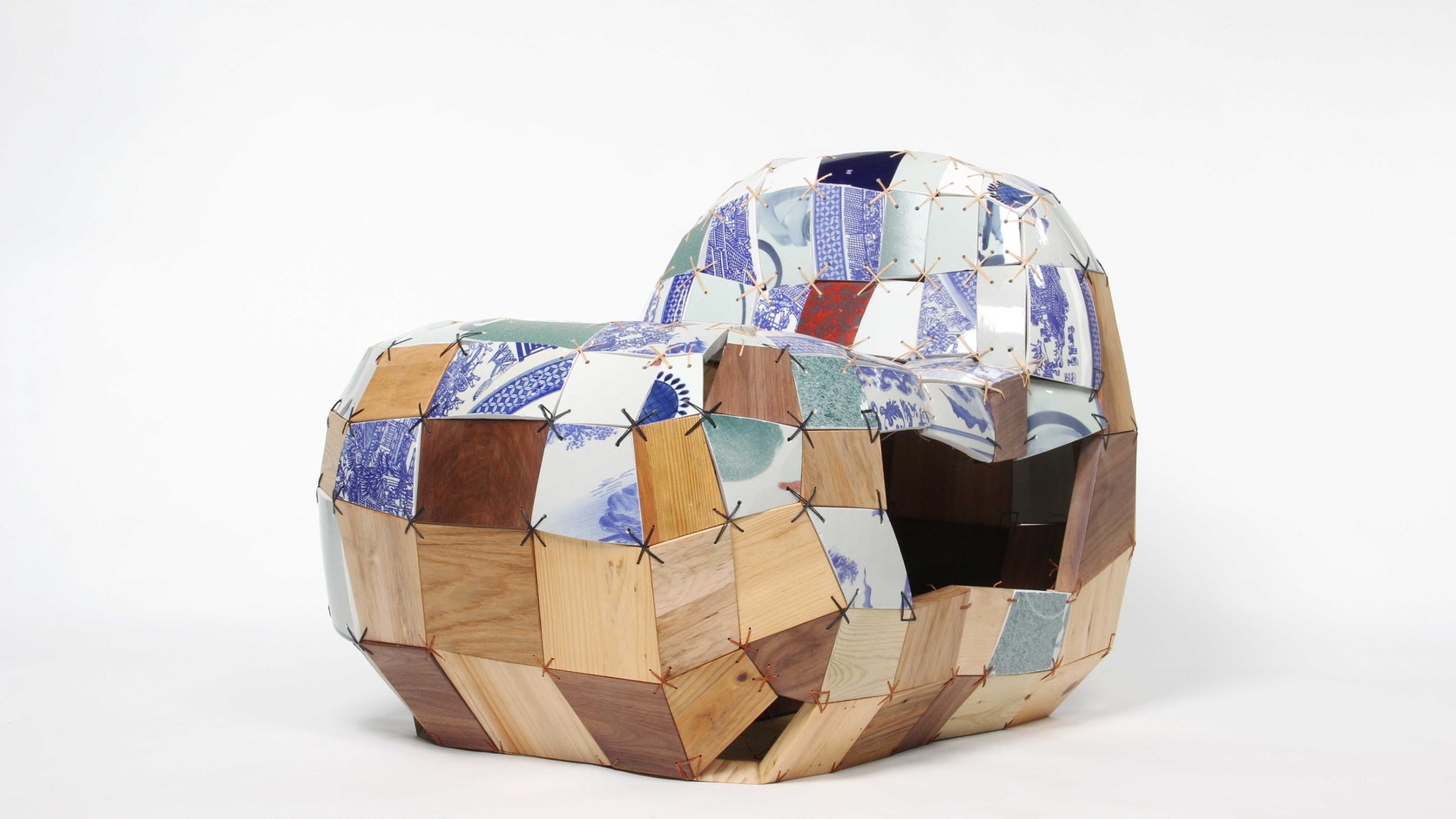
Ten years later, CEWO starts with a different material condition. Its 2023 official record identifies 105 reclaimed ceramic fragments from Jingdezhen and 69 pieces of reclaimed wood from PINWU’s woodworking studio. The pieces retain printed ceramic imagery, timber grain, drilled holes and irregular boundaries.
Instead of returning the fragments to raw feedstock, the design reorganises them at their present scale. The chair becomes a patchwork surface in which previous identities are not erased. Waste is visible because the pieces remain recognisable as pieces.
Stitching turns fragments into a temporary whole
CEWO binds ceramic and wood with visible knots. PINWU links the approach to earlier work with sewn wood pieces and emphasises that the stitching can be cut. The current chair is presented as one stage in a longer material life: fragments may later be dismantled and arranged again.
This reversibility changes the role of the joint. It is not only a hidden technical necessity but part of the conceptual claim. The connection explains how hard, dissimilar fragments can form one surface while keeping the possibility of another configuration open.
From inherited process to future reconfiguration
Piao II, GU and CEWO do not demonstrate one fixed PINWU style. Piao II transfers lamination and lightweight framework. GU transforms a plant-based paper chain into a moulded shell and colour study. CEWO works with existing fragments and a cuttable connection. Across them, the recurring element is a willingness to treat process as design material.
The direction also changes with time. The 2013 chairs focus on how traditional material knowledge can create new structure. CEWO adds a stronger emphasis on reuse and future disassembly. “Future Tradition” becomes less a visual category than a way to keep material knowledge available for another application.
Craft is not reduced to decoration
Traditional references are often easiest to communicate through pattern. PINWU’s selected works take a more demanding route. The paper umbrella contributes a layering method; the lantern contributes a support network; dyeing changes a pulp surface; stitching reorganises fragments. The reference has consequences for how the object is made.
This does not mean the translation preserves every social or technical dimension of the original craft. A furniture object selects particular operations from a larger practice. Responsible interpretation should name that selection rather than claiming that one chair represents an entire tradition.
What the archive allows us to say
PINWU’s pages establish the named designers, dates, listed materials and stated craft references. They provide enough photographic evidence to discuss visible fibres, networks, fragments and knots. They do not establish current production for every work, international availability, edition size, load rating, fire performance, conservation procedure or comfort.
Those omissions are not reasons to dismiss the work. They define the boundary between an editorial design record and an acquisition file. Anyone considering exhibition, commissioning or routine use would need a current technical response from the studio.
Three chairs, one research habit
The strongest connection between the chairs is a habit of asking what a material already knows. Paper making knows how fibres gather; umbrella making knows how layers form a skin; lantern making knows how a fine frame supports volume; broken ceramics retain surfaces that can be joined without being melted away.
Explore the PINWU profile, the Piao II, GU and CEWO product records, and the related Guide on evaluating material-led furniture. Together they separate the studio’s documented craft method from the performance, care and availability questions that remain open.